

Category: Environmental

  • Pleasant Thanksgiving

    Pleasant Thanksgiving

    I hope everyone had a pleasant Thanksgiving. Time now for the end of the year holidays! After 40 years here, I still find warm sunny weather a bit of a turn off for the holidays and long for the cool and dreary weather of December. I’m not usually disappointed. However, holiday cheer is all around as the island decorates for the season. I find lighted palm trees to be especially festive.
    The winter month of December can bring colder temperatures.  In December, we are more likely to have a frost or even the occasional freeze.  Often there can be little rain so using your irrigation system will still be necessary.  However, the cooler temperatures, with highs only in the 70’s and 80’s, means this is the time of year you can save big on those water bills.  Watering once a week or even once every other week will keep your lawns and gardens green as well as helping to reduce the chance of disease.
    If you haven’t applied your fall fertilizer to lawn, shrubs and trees, you should do so as soon as possible.  Healthy, well fed plants will be better able to withstand a frost or freeze.  As plants react to the cold they will slow their uptake of nutrients from the soil making it important to fertilize before the really cold weather or your fertilizer will leach right through the soil and into the surrounding waterways.
    The rate of growth for everything will slow dramatically.  Lawns should be cut every ten to fourteen days instead of every seven.  Shrubs should not be severely pruned again until spring.  Tender new growth would be susceptible to damage from cold.  Light pruning can still be done as necessary.  If you suspect a frost or freeze is on the way it is probably best to avoid pruning.  Cold weather can be very stressful to our tropical plants.  The act of mowing and pruning is another stress the plants don’t need. 
    One exception to severe December pruning is the rose bush.  December and January are months when rose bushes should have a major pruning.  This is important to keep rose bushes in shape and to promote blooming.  Remove all dead and diseased canes and those crowding and rubbing against better canes.
    This is also a good month to plant.  Flower and vegetable gardens can be planted if you haven’t already done so.  Also, planting or transplanting shrubs and trees now allows for good root development as top growth is minimal allowing the plant to concentrate on growing roots.  The same is true for sod and the reduced water requirements means less irrigation will be needed to establish new turf.
    Insects and diseases are not as active but they’re still out there so pay attention and treat if needed.  Watch for gray leaf spot, brown patch and chinch bugs on lawns.  Over watering during the cooler weather can encourage disease as the rate of evaporation is greatly reduced leaving water on plant surfaces and in the soil much longer.  This is the environment fungal spores thrive in.  And that is another good reason to turn your sprinklers back.  Lawns may turn brown in December from both cold damage and disease if watered too often.  A light feeding of ammonium sulfate will usually return it to a nice green color within a week or two.  And that is a quick release nitrogen that the plants will easily use so it won’t leach but will be taken up by the roots to be used by the plants.
    Some of the fruits to enjoy in December include hamlin and pineapple oranges, tangerines, minneola tangelos (although these are much sweeter in another month), calamondins, avocados, kumquats and certain varieties of banana.  This combination makes for a nice tropical holiday fruit bowl.
     So it is time to take some time off, relax your gardening chores a bit and prepare for the holidays.
  • Lawns around Marco

    Lawns around Marco

    A lot of the lawns around Marco are struggling right now. It has been a perfect storm to produce brown, weakened grass. It started with the tremendous summer rains this year which produced a lot of disease. Then fertilizer, which would have strengthened the grass for the cold weather, was not applied until October when it had already turned cold. A lot of slow release fertilizer does not react with cold temperatures and the grass becomes semi dormant and also stops the process of taking in and using nutrients. So the fertilizer applied for the fall feeding is mostly sitting there and leaching through the soil and into the ground water with every sprinkler watering it gets. Add to that the drought we have been experiencing for the last two months and that completes the perfect storm. If your grass is brown in areas look closely to see if it is crab grass which will turn brown with this type of weather. That’s a good thing as it will weaken it. And feel the soil to see if there is adequate moisture. If so the lawn is suffering from the above problems. Do not water more as you will just fuel the disease and wash more of your fertilizer into the ground. Have a fungicide applied and consider turning off the sprinklers for a week or two or cut back to once a week to let the lawn dry out. Following is more on the care of your grass.
    Proper mowing of your lawn can kill weeds and chinch bugs, cure disease, save water and provide fertilizer. However, improper mowing can be harmful. Mowing is stressful to grass because it is meant to grow tall, mature and make seeds. Man decided that lawns look better when freshly mowed and most people feel the shorter the better. But a close cut doesn’t do much for your lawn or your water bill.
    Grasses are basal-growing plants. The growing point is at the crown (the area between the root and the blade) of the plant near the soil line. The tips are the oldest part of the blade which means you can cut off their tops without killing them. When you cut the tips, new growth pushes up from the crown. When the mower cuts off those grass tips, it causes severe shock to the grass plant. Grass lives primarily on food manufactured in its blades not on what is drawn up through the roots. Cutting the blades reduces the ability of the plant to manufacture food. That food is used for both top and root growth so the shorter you cut the grass the less root growth you will have. A plant with deep roots will be better able to withstand drought, fight off disease and insects and store food manufactured in the leaves. So the longer the root the healthier the grass. Every time the grass is cut the root system is weakened to some degree. When cut too severely, the roots stop growing. Mowing tears the plant and creates ports of entry for disease. Sharp mower blades give a cleaner cut which heals faster. Another problem with close cutting is that it allows sunlight to dry the soil and the additional light will encourage weed seeds to germinate.
    Mowing has actually tamed the wild grasses of our past. Mowing grass before it sets seeds prevents sexual reproduction and many grasses respond by reproducing asexually by spreading stolons and rhizomes creating a thicker lawn. How high you mow will also influence the spread of the grass. A higher cut makes healthier grass with deeper roots, more mass for photosynthesis and more stolons and rhizomes for a thicker sod which means less weed invasion.
    You should also take into account that grass grows at different rates throughout the seasons. The summer months require more frequent mowing than our cold winter and dry spring months when you should not cut as often. Our coming cold weather will slow the growth and bi-weekly mowing will be all that is needed. Some lawns could go three weeks or a month without mowing. If the grass doesn’t need to be mowed save it from the extra stress and don’t mow it. As we move into the dry spring months grasses will be stressed by heat and drought so care must be taken to properly irrigate to help ease the stress of mowing.
    In past years drought required the city to reduce our allowed watering to once a week. The fact is our lawns could easily survive on this schedule and be healthier for it. We should use horticultural practices every day which produce deep-rooted lawns that don’t require excessive water to keep them green. All lawns, properly cared for, could be conditioned to require no more than once a week watering all year. The exception would be during the cold winter months when once every two or three weeks will do. I remember the year the Phase 3 water restriction took affect on Marco Island and everybody thought their lawn would surely die if watered only once a week. People were surprised as their lawns remained green and lush. It was because it was during the winter months with the cooler temperatures and lower evaporation rates. That benefit ends as the temperatures begin to climb in March, April and May. Spring is when the benefit of a deep root system and tall grass blades come in to play to allow for less watering.
    Check your irrigation system to be sure of proper coverage. It may seem that the sprinklers are reaching all areas but if you have dry spots on the edge of your sprinkler pattern you may not be getting adequate water at the edges of the sprinkler pattern. Place some empty tuna cans at the center of the green areas and also in the dry areas and measure the water levels after the zone has run. You’ll most likely find you’re not getting enough in the dry areas. This could be dirt in the sprinkler tip, heads not properly spaced or water pressure problems when the sprinklers are running in the wee hours of the morning. When not mowing every week be sure the sprinkler heads stay well cleared of taller grass blades to allow for proper coverage.
    It was once believed that grass clippings were the cause of thatch accumulation in the lawn. It is now known that they do not accumulate unless the clippings are exceptionally long. They break down soon after they hit the ground. In the process they return a lot of nitrogen to the soil. Clippings are a very good thing and should be left to break down and feed you lawn.
    A lush, green lawn is a beautiful thing. It doesn’t need excessive chemical and water use to look that way if you just raise the mower deck as high as it will go. A deeper lawn is a healthy lawn!
  • This is early for such cold weather

    This is early for such cold weather

    This is very early for such cold weather.  We had been enjoying beautiful weather in the 80’s when some very cold weather from the north dipped low enough to bring our temperatures into the 40’s and 50’s.  I’m sure our plants are as confused as we are.
    The cold weather came along with some very windy weather which causes a type of cold injury called plant desiccation or drying out.  This causes leaf-tips to burn in mild cases and totally brown leaves in severe cases.  Desiccation occurs when dry winds and solar radiation cause the loss of more water from the leaves than can be absorbed and transported by a cold or frozen root system.  Plants located in the open and exposed to those cold, drying winds will be brown and void of leaves.  Some plants may die from this but most will recover and new leaves will begin to emerge on the seemingly dead branches.  Leaves on a lot of shrubs and trees will begin turning yellow and dropping after this kind of weather.  Hibiscus, gardenias, bougainvillea, gumbo limbo trees, and most tropical and subtropical plants in our landscapes will have this reaction to the cold.
    This will happen in a big way two to three weeks from now so remember this is when and why it happened!  And also be sure not to over water your landscapes since the lower temperatures and fog can leave landscapes wet for longer periods of time causing disease to become a problem.  Especially on cold damaged plants.  Also remember lawns will be affected as well.  St Augustine grass is a warm season grass which is susceptible to freeze damage.  Blades will turn brown throughout otherwise healthy lawns.  A treatment of fungicide will help protect healthy growth on plants from succumbing to disease problems.  If you have patches of crab grass this is probably already brown from the previous cold weather and over watering will just fuel the growth of crab grass since it loves nothing better than a lot of water.  And a lot of water will do nothing to turn it or cold damaged lawns and plants green again.  When it is time to fertilize for spring,  that will be the best way to green up your cold damaged landscapes.  Wait until you are sure no more of this winter weather is coming this far south to fertilize.  You don’t want to wake up plants causing tender new growth which can then be damaged with another freeze.
    Our landscapes are already in a slight dormancy due to the lower temperatures earlier in the fall which causes a slight slowing of growth for tropical and subtropical plants. Tropical plants and annuals do not normally adapt to withstand temperatures below freezing and can be injured when temperatures reach below 50 degrees F.  Fortunately, freezing temperatures are rare for South Florida and even more rare on coastal islands like Marco.  
    However, subtropical plants can, under the right conditions, acclimate to withstand freezing temperatures.  The ability of plants to withstand freezing temperatures is affected by temperature fluctuations and day lengths before a freeze.  A gradual decrease in temperatures helps plants to harden and withstand cold temperatures.  We have not had enough periods of lower temperatures to hardened our plants.  And if these cold temperatures are followed by periods of warmer temperatures that can de-acclimate plants resulting in budding or flowering making these plants more prone to freeze injury.  Like I said our plants are as confused as we are with this weather.
    Cold injury can occur to the entire plant or just some parts of the plant such as fruit, flowers, buds, leaves, trunks, stems or roots.  The fruit and roots are most vulnerable to cold damage.  Especially roots of container plants.  This damage won’t usually become evident until the plant is stressed by higher temperatures in the spring.
    Steps, from selection of proper planting sites to good cultural practices, can help acclimate plants to cold temperatures and protect them from temperature extremes.
    Site selection.  Temperatures can fluctuate from one location to another in most yards.  Thus, microclimates should be considered when choosing the planting site for cold sensitive plants.  Tender plants should be planted in areas with good air flow never in low areas where cold air settles.  Arranging plants, fences and other barriers to help protect plants from the cold winds of advective freezes can help.  Avoid poorly drained soils which will result in shallow, weak root systems making plants more susceptible to cold damage.
    Plant nutrition.  Properly fertilized plants will tolerate cold temperatures better and recover from injury faster than weak, underfed plants.  That is why it is so important to fertilize in the fall before the cold weather of winter arrives.  After the cold weather arrives plants will not “take up” or use fertilizer applied due to the dormancy.
    Shading.  Tree canopy covers can reduce cold injury caused by radiation freezes.  Canopies can raise night temperatures under them by reducing heat loss into the atmosphere.  Early morning sun after a freeze can cause bark splitting on plants and the shade can help prevent this problem.  However, be sure shrubs planted in the shade are shade tolerant or you will end up with sickly plants which will also be more vulnerable to cold injury.
    Watering your landscape before a freeze can help because a wet soil will absorb more solar radiation than dry soil and will re-radiate this heat during the night.  However, it is not good to saturate soil for prolonged periods as this could cause root damage.
    Avoid late fall pruning which can result in budding and a new flush of growth.  This tender, new growth is more susceptible to cold injury.  This is why they tell you not to do any hard pruning after October 15th.  
    Keep your plants healthy.  Plants weakened by insects or diseases are not as resistant to the cold.  Inspect your plants regularly and treat them as necessary to avoid serious problems.
    Potted plants that can be moved indoors for a freeze should be.  Larger containers that must be left out should be pushed together and mulched to reduce heat loss from the tops and sides of the containers.  This will help protect the roots.  The soil should be moist not dry.  Be careful not to leave canopies of plants together for extended periods as this could cause leaf and stem damage.
    Radiant heat from the soil will protect low growing plants on cold, calm nights.  Taller plants do not enjoy this benefit as much because of their distance from the soil.  Mulches help to reduce heat loss from the soil helping to protect root systems.
    Covering your plants should be done carefully.  Covers that extend to the ground and are not in contact with the foliage can trap radiant heat from the soil and plant.  Foliage in contact with the cover can be injured because the heat transfers from the foliage to the colder cover and is lost.  You can purchase special “frost blankets” from the local garden center or use old sheets or blankets.  Plastic is not recommended but if it is all you have, be sure to remove it promptly the next day to avoid burning your plants with trapped solar radiation.
    Marco Island is usually spared the severe damage suffered by the inland communities due to our close proximity to the water.  Just remember to be prepared as it does happen and when it does we can lose a lot of our more tropical plants.  Winter has not even begun.  Serious freezing weather can just as easily cross over the bridge so prepare your landscapes for it now.  
  • Snow has already been falling in some of the northern states

    Snow has already been falling in some of the northern states

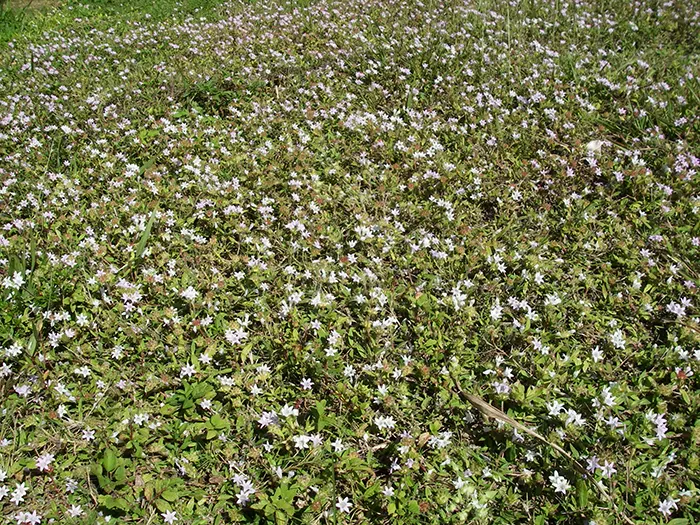
    Snow has already been falling in some of the northern states and our own “Florida snow” is beginning to bloom on lawns around Marco Island. The weed is Florida pusley (Richardia scabra) and is a native to Florida. This weed is aggressive and will take over turf areas which are thin from irrigation, bug or fungus problems. The leaves and stems are hairy with opposite leaves. The flowers start white and turn to purple as they age. This weed grows into a large clump forming from a single stem. This makes the weed easy to remove physically when you have a small infestation. And if you enjoy pulling weeds I highly recommend you get the upper hand on pusley with this environmentally friendly method.
    If your lawn is adjacent to a vacant lot or to a lawn which is poorly maintained and is infested with Florida pusley, it will be a constant battle to control this weed in your lawn since it spreads by seed. Weeds can get a foothold in your lawn in areas where the grass is thin or weak. Weeds do not overtake healthy turf. St. Augustine is a very aggressive and competitive grass allowing it to compete with weeds. As I’ve said before, St. Augustine grass could overtake and kill most shrubs in your yard.
    Most weeds appear because of improper cultural practices such as mowing too closely or infrequently, improper fertilization or irrigation. These are the primary causes for thin or weak turf. In addition, inadequate control of insects, diseases, and nematodes will also damage the turf and allow weeds to invade.
    Herbicides may temporarily remove the weeds, however, unless the basic cause of the weakened turf is corrected, weeds like pusley will continue to be a major problem. Weed control will only be successful if the turf is returned to a good healthy growing condition. The healthy, thick blanket of grass will not allow weeds to germinate at the soil line.
    Pre-emergence herbicides provide several weeks of residual control in the soil and will kill the seedling weeds as they emerge. Pre-emergence herbicides should be applied before germination of the weed seeds. The timing of applications of this type of herbicide must coincide with the various germination times of weed species. For pusley, if it is above freezing this weed is germinating.
    Once weeds have germinated and are actively growing they must be controlled with post-emergence herbicides. Atrizine can be used in St Augustine grass to control most broadleaf and annual grass weeds. Trimic can be used in bahia grass to control most broadleaf weeds. Both seem to be somewhat effective against pusley. A call to your lawn spray company for other herbicides should be helpful. Use only herbicides labeled for your type of grass as severe injury or death will usually result if the wrong type of herbicide is applied. Herbicides in general should not be applied to freshly mowed turf or to turf under stress.
    Weeds are easier to control when in the seedling stage or when large and actively growing. Applications made to weeds under stress may reduce the effectiveness. It sounds strange but you want your weeds to be healthy and actively growing. Post-emergence herbicides are absorbed through the foliage, roots or both and then trans-located throughout the plant. If conditions are dry, you want to irrigate prior to application to ensure active growth. Fertilization prior to application is also a good idea. Do not water or mow for several days following herbicide application to give the chemicals time to absorb into the weeds. Always avoid applying any herbicide during extreme hot or cold temperatures to avoid damage to the grass.
     Crabgrass is another major problem in local lawns and control will require a special herbicide. They have taken the best product, Azulox, off the market but there are some replacements appearing. Cinnamon and baking soda are two popular crab grass treatments. These are not as effective and so patience and a healthy turf will be necessary when trying to kill crab grass using these natural remedies. They are contact herbicides and you can gain a degree of control, on small crab grass patches, when sprinkled lightly on top of wet patches of crab grass. You will see results right away as it burns the leaves of the plant. Unfortunately, the stolens and roots survive so it is important to limit treatments to small areas so as not to stress the St. Augustine or Bahai grass allowing it to grow and take over these areas again.
    While herbicides can help with the weed control in your lawn the best way to a weed free lawn is to practice good horticultural practices like proper watering, mowing, insect and disease control to prevent weak areas which will be susceptible to weed invasions from the likes of Florida pusley and crab grass. Or you can embrace the lovely look of Florida snow. Doug Caldwell says the bees like it and bees are in serious trouble and can use all the help we can give them.
  • Proper irrigation for plant health

    Proper irrigation for plant health

    Proper irrigation is very important for plant health. Too much or too little can both be damaging to plants.
    I’ll begin with a description of a process called evapotranspiration.  This process combines evaporation and transpiration.  Evaporation is when water changes from a liquid to a gas and moves into the atmosphere from the surface of bodies of water, wet soil or wet plants.  Transpiration is a process the plant uses to cool itself.  Water is taken up by the roots from the soil or into the leaves from rain or irrigation and translocated through the plant and exits from the stomata in the leaves cooling the plant as it exits.  The process is much like our own perspiration for cooling our bodies.
    Evapotranspiration rates vary with the type of plants as well as the weather.  And irrigation should be adjusted accordingly to avoid the dreaded over and under watering I mentioned.  The hot, dry and windy spring months have the highest evaporation rates.  But the hottest months of summer are also have some of the highest evaporation rates.  It is a common practice to turn irrigation systems off during the summer rainy season but this causes the death of many lawns in the summer.  Rain can be sporadic to nonexistent at times and it doesn’t take long for our sandy soils to experience drought conditions.  And that means the plants have no water to take up from the soil or absorb from rain and no way to cool off during months with the highest transpiration need.  It’s like a person being stuck in the desert with no water.  The cooler months of late fall and winter are the months to save on your water bill since the evapotranspiration rate decreases greatly during those months.  And many people over water in the cooler months because there is less rain and they feel the plants need more irrigation which brings on disease.  And then if disease does appear it causes the cells to collapse and so they cannot translocate the water and the plants turn brown which people mistake for a need for more water.  In fact they are feeding the fungus and causing death. 
    The main objective is to grow plants that will survive with little to no irrigation.  You want a deep extensive root system which can be achieved using proper management practices.  And proper irrigation is the first step.
    Frequent light watering can cause a shallow root system.  To develop a deep root system you should only water when plants show a sign of need.  Like wilting.  This is usually only twice a week at most and preferably only once a week.  And when you do water only apply enough to wet the root zone, approximately ½ to ¾ of an inch with each watering.
    The next step is to figure out how long to irrigate to apply ½ inch to your lawn and plants.  Most people run the sprinklers for a given number of minutes without knowing how much water they are really applying.  Determining the rate of water your system applies is a pretty easy job.
    • Obtain five to ten straight sided containers to catch the irrigation water. Tuna cans or something similar in size are perfect.
    • Place the containers in one zone at a time scattering them at random within the zone. Repeat this in every zone because there may be differences in the irrigation rates.
    • Run the water for fifteen minutes.
    • Use a ruler to measure the depth of water in each container. Measurements to the nearest eighth of an inch are adequate.
    • Find the average depth by adding the depths and then divide by the number of containers.
    • To determine the irrigation rate in inches per hour multiply the average depth of water times four.
    Try to calibrate the system at the same time of day that it is run so that water pressures are similar. Low water pressure can reduce the amount and coverage of water applied by the system.
    Never mix sprinkler head types.  Mist heads apply more water than stream and rotor heads.  You need to match sprinkler heads for uniform coverage.  A mist head can apply the needed ½ inch in 15 minutes where a rotor head will need 30 to 60 minutes depending on whether it is a 180 degree radius or a 360 degree radius.  If you mix these in the same zone you will be applying too much or too little depending on how long you program the zone to run.  Match sprinkler heads for uniform coverage.  It can take a month or two to condition your yard to survive several days between irrigation or rainfall.  During this time the root system is developing and growing deeper into the soil.
    You need to check your system frequently, especially if you see dry spots appearing on the lawn or shrubs and flowers wilting.    You may have broken heads, clogged nozzles or need to adjust the direction of the spray.  Also check that shrubs have not grown over the heads and are now blocking the water from reaching areas.  You should not run the sprinklers longer trying to turn the brown spots green because most likely there is no water reaching those areas and running it longer will not change that.
    Watering your flower beds should be a special consideration.  Overhead watering can cause disease and so drip irrigation is the way to go.  It is best to tap into a rotor head zone if possible since they will typically run for 45 to 60 minutes which is ideal for a drip irrigated flower bed.
    Lawn zones should be separate from shrub zones since they need to run longer and tend to have rotor rather than mist heads.  It depends on where the lawn zone is located.  Is it in the full sun or shade?  On a hill or flat surface?  Do the heads need to turn 180 or 360 degrees.  You need to time the zone according to the different conditions. 
    Shrubs may need little to no irrigation once they are established.   Shrubs have a more extensive root system than either lawns or flowers and so can go longer between watering than either of those. 
  • Learning how to propagate plants

    Learning how to propagate plants

    Learning how to propagate plants is an exciting way to share your plants with others.
    Plants can be propagated by sexual or asexual means.  Sexual propagation is starting plants from seed.   Multiplying of plants from vegetative plant parts such as shoots, roots and leaves or bulbs and corms is called asexual propagation.
    Asexual propagation will grow plants with the same characteristics as the parent plant.  It is the best method of reproduction when a plant produces seeds which are difficult to germinate.  The most common method of asexual propagation is from cuttings.  Cuttings can be made from stems, roots and leaves.  Cuttings should be taken from healthy plants and placed in a warm, humid environment to encourage root development and prevent them from drying.
    Stem cuttings can be taken at different stages of vegetative maturity, from just the growing tip of a stem or stem sections, depending on the plant being propagated.  Softwood cuttings are generally taken from plants in spring or early summer during a growth flush when tissue is soft and succulent.  Semi-hardwood cuttings are taken after a growth flush has matured.
    Stem cuttings are removed using a clean, sharp pruner.  Cuttings should be four to six inches in length.  Remove the leaves from the bottom one inch of the stem cuttings and then stick them just deep enough to hold them upright into a medium suitable for propagation.  A mixture of equal parts of peat moss and course pearlite is a suitable rooting medium for most plants.  Combinations of other materials such as shredded sphagnum, vermiculite and sand will also do.  The medium should drain freely and be free of disease and weed seeds.  Root promoting chemicals can be applied to the ends of cuttings before sticking them in the medium to enhance rooting.  These rooting hormone preparations are available at most garden centers.
    Leaf cuttings might be only the leaf blade or the leaf blade and petiole (leaf-stem).  Begonias are commonly propagated by leaf cuttings.  Leaf cuttings are cut on the underside of the main veins then placed flat and in firm contact with the medium.  It can be helpful to pin the leaves in place with small stakes or toothpicks.  Or, leaf cuttings can be stuck upright in the medium making sure the basal end of the cutting is inserted into the medium.  Roots and new shoots will start at the base of the leaf or at points where veins were cut.
    Leaf bud cuttings include the leaf blade, the petiole and one inch of the stem.  Axillary buds located at the union of the petiole and stem produce new shoots when in warm and humid conditions.  This method is used for plants in short supply that have long inter-nodes since every node on the stem can be a cutting.
    Root cuttings are taken from young plants in late winter or early spring, before they start growing.  Healthy roots will have ample food stored to support shoot development at this time.  Cuttings are usually two to seven inches long.  Small root cuttings should be put horizontally in the medium and covered with one half inch of medium.  Larger root cuttings can be planted vertically with the end of the cutting that was originally nearest the plant crown positioned upward.  The best temperatures for most root cuttings range from 55F to 65F.
    Layering is an easy method of propagation by which new plants are formed while attached to the parent plant.  The new plant receives nutrients and water from the parent plant until roots develop.  Healthy, maturing branches that are growing vigorously should be chosen for layering since these have more food reserve and root faster.  Branches from pencil size to three quarters inch in diameter are best for layering.  Wood that would normally be pruned while shaping the plant is often suitable for layering.  Various types of layering are air, tip, trench, mound and serpentine.  Air and tip layering are the most popular methods.
    Air layering is commonly used for propagation of fiddle-leaf figs, rubber plants, crotons, hibiscus, oleanders, camellias and azaleas.  The first step is to remove leaves and twigs on the selected limb for three to four inches above and below where the air layer is to be made.  This is usually made a foot to a foot and a half below the tip of the branch.  The branch is wounded by either removing a one inch ring of bark and scraping clean the wood underneath or by making a long slanted cut upward about half way through the twig.  This incision should be kept open with a small chip of wood or toothpick to prevent the cut from healing over.  The wounded area should be bound with a handful of moist, but not wet, sphagnum moss.  Tie the moss firmly in place and wrap the sphagnum ball with clear plastic and tie securely above and below the ball to prevent the moss from drying.  Cover with aluminum foil to prevent excessive heat build up from the sun.  When a mass of roots has developed in the sphagnum ball (one month to one year) the layered branch can be removed from the parent plant.  Before planting the new plant in the garden it is best to allow the plant to develop a larger root system in a container or protected area to avoid high light and dry conditions.
    Tip layering is good for propagating climbing roses, jasmine, oleander or pyracantha.  Most vines can be propagated using this method.  A low branch, or one that can be bent to the ground, has a one inch wound applied four to five inches from the tip.  The wounded area is anchored two to three inches in the soil.  It is once again important to keep the soil moist.  The layered section should have roots before removal from the parent plant.
    Trench and serpentine layering are similar to tip layering except that a longer branch is placed in a trench and covered with soil.  These methods produce several new plants from each layered branch.  Trench layering is useful on plants whose buds will break and grow under the soil surface such as willows, viburnum and dogwood.  Serpentine layering involves burying every other bud, leaving the alternate bud above ground.  This method requires plants with pliable, vine-like stems such as grapes and confederate jasmine.
    Mound layering can be used to propagate heavy stemmed or closely branched plants such as crotons or tibouchina.  Mound layering is started in the spring.  The plant is cut back severely just before spring growth.  The new shoots that emerge are wounded and soil is mounded around the base of the plant in several stages about one and a half feet.  Add peat or sphagnum moss to the mounding soil to help removing rooted branches.  It takes about one growing season to produce shoots that have rooted sufficiently for transplanting.
    Plants with a multi stem or clumping habit of growth, off shoots, or with underground storage structures such as rhizomes or tubers can be propagated by division.  This involves cutting large clumps into smaller sections, making sure each section has as adequate amount of stems, leaves, roots and buds to survive transplanting.  Ferns, orchids, daylilies, bulbous plants and liriope can be propagated this way.  Some plants can be pulled apart but many must be cut.  Do not divide plants when they are flowering, but any other time of the growing season is fine.
    And the last and least expensive way to produce large numbers of new plants is seed propagation.  A disadvantage of this method of propagation is that seedling characteristics are usually quite variable.  Seed propagation is a means of reproducing plants that are extremely difficult or impossible to propagate vegetatively.  Most palms are grown from seed because they are single stemmed and cuttings cannot be taken without destroying the parent plant.
    The sooner you start propagating the sooner you’ll enjoy some new plants for your landscape or to share with friends.
  • Snow birds and tourists return to the island

    Snow birds and tourists return to the island

    This is the time of year when snow birds and tourists return to the island.  Everyone is busy cleaning the last of the summer growth from their landscapes.  Many people will begin mulching their gardens as mulching will add uniformity to the landscape which makes it appear neat and pleasing to the eye.
    If your landscape is planted and maintained properly over the years you should need less and less mulch. Plants should be allowed to mature so that they become one large mass in your garden beds and should always be trimmed so that the foliage shades the ground underneath.  This does not allow weed seeds to germinate due to the lack of sunlight.  But mulching plant beds in the landscape is a good thing to do for many reasons.  Mulch cools the soil to help retains soil moisture, reduces weed growth in open areas, and decomposes to add organic matter to the soil.  It will cover the sticks and leaves left behind by summer’s excessive growth which will decompose and generate more organic matter to help combat poor sandy soil conditions.  And actually the most environmentally friendly thing to do is leave the leaves and twigs from your shrubs and trees as a natural mulch to add organic matter.  Unless you are suffering with leaf or other diseases in which case you should remove the diseased litter.
    Mulch should be applied evenly throughout the beds at a depth of 4 inches if this is the first application or 2 to 3 inches if previously mulched beds are being redressed.  Always leave an inch or two of breathing space around the stems or trunks or the plants and trees.  Mulch applied next to plant stems can cause rot from the constant moisture and this could result in their death. 
    Never mulch citrus trees.  Citrus trees prefer a clean, raked soil under them out to the drip line.  They have very shallow feeder roots which are susceptible to disease when constantly moist.  If the tree develops foot rot it will attack the bark of the lower trunk causing it to peel and lift away.  In time this will girdle the entire tree causing death.  Once the disease appears it is not curable.  You can try to slow the progress of the disease by cleaning the loose bark and applying a fungicide to the area.
    There are many types of mulch to choose from.  Chipped is cheaper than shredded mulch.  The chipped mulch will wash away much quicker than shredded.  Shredded will matt together and stay in place while it decomposes.  You can get shredded or chipped mulches made from the wood of cypress, eucalyptus or Florimulch from the melaleuca tree.  Another type of mulch is pine-bark.  This mulch tends to stay in place a long time and has a more rustic look.  Or pine-straw, which is really pine-needles and has a soft, fluffy appearance and adds acid to your sandy, alkaline soil. The various types of mulch are all different in color and smell so it is really a matter of personal preference which is the best.  Since the melaleuca tree is a nuisance tree which we are trying to eradicate from our native forests, Florimulch or Enviromulch would be good choices environmentally.
    The dyed or colored mulches like red, black and gold mulch, which have been very popular since coming on the market, may be hazardous to your health.  Two Florida engineers, Helena Solo-Gabriele of the University of Miami and Tim Townsend of the University of Florida studied the use of lumber debris.  Some dyed mulch is made from lumber debris.  Dyed landscape mulch containing wood treated with CCA(chromium, copper and arsenic), or better known as pressure treated wood can raise the level of arsenic in soil above safe levels.  Walt Disney World will not use treated lumber anywhere they keep animals.  Cooperative Extension agents advise against using CCA treated wood in vegetable and fruit gardens or in children=s play areas.  While not all dyed mulch contains debris from pressure treated wood, some brands do.  If you still want to use this kind of mulch, you should examine it closely looking for particle board or plywood.  If the mulch contains either try buying another brand or kind. Marco is a small island and we use our ground water through reverse osmosis.  You should use dyed mulch cautiously.  Most of the dyed mulches sold locally are from trees and not lumber.
    Florimulch or Enviromulch have been around for many years.  It used to be hard to find but is becoming more popular.  I have always been intrigued by this mulch as a good replacement for cypress mulch, which is the mulch most people use.  Cypress trees are very slow growing and we are cutting them down at an alarming rate to mulch our gardens.  Melaleuca, on the other hand, is a tree we are trying to eradicate from our native forests.  This mulch also seems to repel many insects including termites.  And it is not contaminated with arsenic and other chemicals found in the dyed, recycled wood mulches.  It decomposes more slowly and is a no-float mulch.  However it has a finer texture than most mulches.
    Florimulch or Enviromulch or a high quality dyed mulch are my top choices for mulching your gardens.  They are an easy way to help the environment while improving your property.  It costs a little more for a bag than other mulches but you should just consider that a charitable contribution to helping our native forests.
    How much mulch will you need?  By the bag.  At a depth of 2 inches a 2 cu.ft. bag will cover 12 sq.ft. and a 3 cu.ft. bag will cover 16 sq.ft.  At a depth of 3 inches a 2 cu.ft. bag will cover 8 sq.ft. and a 3 cu.ft. bag will cover 12 sq.ft.  At a depth of 4 inches a 2 cu.ft. bag will cover 6 sq.ft. and a 3 cu.ft. bag will cover 8 sq.ft.  In bulk. 1 cu.yd. will cover 162 sq.ft at a depth of 2 inches – 129 sq.ft. at 3 inches or 81 sq.ft. at 4 inches. To figure area multiply length times width.
    Most Marco yards will need at least one pallet (75 to 80 bags) of mulch to cover their gardens.  Larger yards can use several more pallets.  It is a common site to see the landscape suppliers hauling pallets of mulch around the island.  Our nursery alone will sell over 100,000 bags of mulch in the next three months. Let the mulching begin!
  • Fall is here and the month of October will bring cooler and dryer weather to our gardens

    Fall is here and the month of October will bring cooler and dryer weather to our gardens

    Fall is here and the month of October will bring cooler and dryer weather to our gardens. Well, dryer except when hurricanes appear. The month begins with high temperatures in the 90’s but ends with highs in the mid-80’s. Lows will be in the mid 60’s and could go as low as the 50’s. Fall also signals the end of the rainy season. Early October can still see heavy rains like we are experiencing now, but we can become very dry by month’s end. This is a good time to check your irrigation system to be sure it is in good repair.
    Remember to get your fertilizing done this month so your lawn and plants will be healthy going into winter and the dry months. Once the cooler temperatures arrive the slow release fertilizers may not react due to cooler soil temperatures and dormant plants. The last fertilization of citrus should be applied this month to help the fruit mature and ripen. Most shrubs will get adequate fertilizer when you fertilize the lawn just by allowing it to spread into the gardens when applying it to your lawn. Some of the more needy plants may need an application especially for them. Gardenias, hibiscus or newly installed plants are some examples. Remember less is always best for the environment. Integrated Pest Management applies to fertilizer as well as chemicals. If the plant doesn’t need to be sprayed or fertilized, don’t.
    This is a good month to apply mulch. The heavy downpours of summer, which can wash mulch away, are just about over and mulch will dress the garden beds for the return of the winter season. It will also help to conserve water and retard weed growth. Weeds have taken over these last two months. We are spraying to kill them and mulch would certainly help this process.
    This is the last month to do any severe pruning. After mid-month the cold weather will begin to arrive and our more tropical plants will need their foliage to protect them. Plants cut too severely will have tender new growth which could be damaged by temperatures in the 50’s. After a late hurricane it can be impossible not to cut some shrubs back farther than is desirable for this time of year since they could been broken or blown over. Fortunately, really cold weather can still be a little late in arriving and the majority of the plants should survive.
    This is the time to start planning for vegetable and flower gardens. Prepare your beds by tilling the soil and adding amendments like peat and manure. Then let the beds rest until the cooler weather arrives to begin planting. This is also a good month to plant bulbs. And if there are some plants from the north you would love to plant in your garden you can do so after you feel the cooler winds. They will last until our hot weather returns in late spring. We could all use a little bright spot of color in the landscape so bring on the flowers!
    Insect pests like scale, chinch bugs, grubs, white fly and mites, once it becomes dry, will still be active. Watch for them and treat if necessary. You will find fewer pest problems with the onset of cooler weather. Disease is a problem right now, especially on lawns. The heavy rains of summer depleted our sandy soil of nutrients and we were not allowed to feed plants and lawns as we saw this happening. You will need to treat with a fungicide now to get this under control and let the fertilizer do its job at strengthening the plants so they can grow out of the problem. Remember that fungicides do not cure disease, they only protect the healthy part of the plant and prevent disease from spreading to healthy plant parts that have not been affected. A healthy plant is better able to defend itself from disease and insects. People who eat right won’t have to take medicine to cure the diseases brought on by an inadequate diet. The same is true of using chemicals to cure plants that have not been fed when they need it.
    Weeds will also invade a week lawn but not so much a healthy, vigorous one. If weeds have invaded your lawn wait until after the temperatures are in the low 80’s and it will be safe to treat your lawn for weeds. Early October can still be too hot to apply Atrizine or other herbicides so be sure to wait for the cooler weather to avoid damage.
    With the cooler weather also comes less growth and that means less hard labor to keep the yard in order. Come on winter! I know I am ready for a break.
  • Many pests can feed on hibiscus

    Many pests can feed on hibiscus

    As I mentioned in my last column about hibiscus, many pests can feed on hibiscus making this a very high maintenance choice for your landscape. Chewing insects include caterpillars, grasshoppers, snails and slugs, beetles, cut worms & leaf miners. Piercing-sucking insects include scale, mealybugs, spider mites, aphids, whiteflies and thrips. And, the newest addition to the list, the Two spot cotton leafhopper which I wrote about in my last column. These pests are more of a problem in areas of poor circulation. The grenade scale can be hard to see because it blends with the bark. This soft scale will cause branches to die back.
    Premature, flower bud-drop has become a more serious problem with hibiscus. Some varieties, especially some doubles, exhibit a chronic problem with premature dropping of buds. Other varieties bloom well during one period of the year and consistently drop their buds at other times. This is why variety selection can be important. Nematodes, nutritional deficiencies, over fertilization, and environmental factors such as poor drainage and excessive water, drought, or salt spray can all cause flower buds to drop. Bud drop can be caused by insects such as thrips, caterpillars or an insect pest called the gall midge. This flying insect larva lives in the base of the flower bud. If you pull apart the dying flower bud you will find these tiny, yellow maggots wiggling around. To combat these pests good housekeeping is a must. Try to rake the fallen flower buds as much as possible. Then spray the plant, especially the buds, and drench the soil beneath it with a mixture of a systemic insecticide like Merit and an insect growth regulator like Intercept or Neem. Or a soil application of Bayer Advanced Garden Tree and Shrub Insect Control. This will give you extended protection for a few months. Hibiscus is sensitive to many pesticides so be sure to read the label before applying. The safest time to spray is early morning rather than in the middle of a hot sunny day.
    Another pest, the pink hibiscus mealybug was killing the hibiscus on Marco Island in a big way. Many people arrived for the season finding damaged or dead hibiscus in their yards. This pest is reminiscent of the sago scale which caused many to remove sagos from the landscape as they became to expensive to maintain.
    The Pink Hibiscus Mealybug came to us via the East Coast from Broward and Miami-Dade counties a few years ago and began multiplying and spreading very quickly throughout the island. This insect is originally from other tropical areas of the world such as Africa, Asia and Australia. It was found closer to home in the Caribbean in 1994 and made its way to the East Coast of Florida in Broward and Dade counties in mid 2002. This pest is expected to colonize the entire state of Florida and into Georgia.
    The adult mealybugs are very small (3 mm long) with a pink body covered in short, waxy filaments which cover the entire body. When crushed their body fluids are also pink. The adult males are even smaller, reddish brown with one pair of wings. They also have two long, waxy tails. The freshly laid eggs are orange, turning pink before hatching. The eggs are encased in a cottony egg sac. The nymphs can and do crawl significant distances after hatching to find suitable host plants. They can also be spread by wind. This very prolific insect deposits up to 600 eggs at a time with 15 generations a year. The life cycle is approximately one month long.
    The mealybug is a member of the piercing-sucking insects. As with all sucking insects it feeds on the sap of the plant releasing substances which injure or kill the plant. Sooty mold and ants soon follow. Other symptoms of an infestation include deformed leaves and shoots, unopened, bunched leaves, white cottony mass on buds, stems, fruit and roots, unopened or shriveled flowers or deformed fruit.
    While it is called the Pink Hibiscus Mealybug it can be found on more than 100 different plants.  It can attack fruits such as papaya, carambola, passion fruit, avocado, mango, citrus, guava and bananas.  Many vegetables including tomato, pumpkin, cucumber, lettuce, cabbage, okra, peppers, beans and squash.  Ornamentals affected include hibiscus, croton, allamanda, anthurium, heliconia, seagrape, schefflera, bougainvillea, oleander, ixora, ficus, ginger and lantana.
    While chemical control has not been very effective there has been some improvement. The waxy covering protects the mealybugs and eggs from contact with the chemicals. But biological control does work. The Florida Department of Agriculture, Division of Plant Industry released a beneficial parasitic wasp all over Marco Island a number of years ago. Spraying chemicals to try to control this insect will only kill the beneficial insects trying to kill the mealybugs. So before you reach for the spray take a closer look at the plant to see if you might have these beneficial at work in your yard. You will see the bunched growth with new healthy growth above it. If you squash the bug infested area and it is dry and powdery rather than wet and bloody the mealybugs have been successfully controlled by the beneficial insects. I see the results of these wasps everywhere.
    There are two species of this wasp that will do the trick. Mealybugs parasitized by these wasps will leave behind “mummies” which will have an exit hole where the adult wasp emerges. The adult ladybeetle is also a voracious consumer of mealybugs as is the immature ladybeetle, also known as the “mealybug destroyer”. This insect looks like a colorful mealybug so don’t confuse them.
    The insect can spread by wind very easily and the action of cutting infested branches will dislodge the insects for easier movement through the air.  A lot of people gave up the fight and removed hibiscus from their yards.  Fortunately, enough of the beneficial insects survived and multiplied to make the pink hibiscus mealybug much less likely to kill all of the hibiscus in your yard.  While the program certainly reduced the numbers drastically they are still a problem to watch for.
    Diseases of hibiscus include leaf spot, canker and mushroom root rot. Canker is a fungus disease which causes twigs and branches to die back and sometimes the entire plant is killed. Reddish-orange fruiting bodies can be found on diseased bark. The best control is to prune off and destroy all diseased wood.
    Mushroom root rot will cause hibiscus to wilt suddenly and die a short time later. Poorly drained soils and buried tree stumps or roots encourage this disease. Dead or dying plants should be removed with as much root system as possible and the soil should be replaced or sterilized before replanting.
    Leaf spot may cause the death of affected leaves but usually the spotting is minor and little cause for alarm. The best control is to pick off or rake up the diseased leaves and destroy them.
    Nematodes can cause a decrease in plant vigor. Symptoms include frequent wilting, poor growth, small leaves, and nutritional deficiencies. Soils can be sterilized prior to planting, but no chemical control measures are available to treat established plants. Mulching or adding manure or peat under the plants can reduce nematode damage by creating good soil and thus encouraging their natural enemies.
    Hibiscus is a lovely but high maintenance plant. Unless you are willing to commit time and money for the necessary maintenance hibiscus should be used sparingly in your South Florida gardens.
  • Season for growing vegetables in South Florida

    Season for growing vegetables in South Florida

    This is not only the season for growing annuals in South Florida it is also the season for growing vegetables. You don’t need a lot of land to grow a few vegetable plants and enjoy some fresh produce from your own produce patch. Unfortunately, many gardeners lose their plants because of insects and diseases. Disease causing organisms such as fungi, bacteria, viruses & nematodes are too small to see with the naked eye making diagnosis before damage unlikely. Following are some tips for symptoms and poor horticultural practices to watch out for.
    Fungi can cause stunting, spots, blights, galls or rots on all plant parts.  The time between entry of the fungus and appearance of symptoms can be anywhere from three days to two weeks depending on the disease and plant involved.  Temperature and moisture are two factors which can influence disease development.
    Bacteria can cause many of the same symptoms as fungi including stunting, leaf spots, wilts, fruit rots or galls. Bacteria live and thrive in seeds, transplants, soil and weeds. They can be spread by irrigation and wind driven rains. Bacteria enter plants through natural openings or insect wounds. Incubation periods are three days to a week.
    Viruses will cause leaf mosaics or mottling, fruit mosaics, leaf distortions and stunting. Problems caused by viruses look similar to those caused by herbicides and nutritional deficiencies. They can be spread on seed, especially beans and peas. Aphids can also spread many viruses throughout a garden. Gardens next to a weedy field are more likely to have aphid-transmitted viruses. Incubation periods are from a few days to a few weeks.
    Nematodes are round, worm-shaped animals which live in the soil. There are hundreds of different kinds living in the Florida soils, some which are beneficial. Those which feed on plants can severely reduce the health, vigor, productivity and value of vegetables. Stunting, wilting and slow growth are symptoms of a nematode infected plant.
    Finally, there are issues caused by horticultural problems like nutritional deficiencies or herbicide damage. Blossom end rot of tomatoes and peppers is caused by a calcium deficiency. This deficiency can be caused by soil moisture fluctuations from wet to dry during the growth period. Herbicides used on lawns can drift into the garden causing plant deformation. Chemical burns from insecticides, fungicides and excessive fertilization are possible. You should always use the correct amounts of these chemicals to prevent problems.
    The best control of plant diseases and nematodes is prevention.  How you prepare your  garden before planting is very important.
    1. Site selection – A sunny location helps with plant growth and reducing disease development.
    2. Drainage – Excess soil moisture encourages growth of soil fungi and nematode caused root rots. Too much moisture can deplete oxygen slowing root development and exposing roots to infection by soil fungi.
    3. Soil tillage – Undecomposed plant debris or green plant matter can be a source of fungi, bacteria, viruses and nematodes. Do your tilling early to allow for the breakdown of any green matter.
    4. Disease free seeds – Purchase disease-free seed to avoid many fungal, bacterial and viral diseases which can be transmitted by seed.
    5. Fungicide seed treatment – Seed treated with a fungicide can reduce seed rot and pre-emergent seedling decay caused by fungi. Bulk vegetable seed sold at garden shops is often treated with a fungicide. Seed sold in small packets may not be treated. If seeds appear to be coated with brightly colored dye that is a sign that the seeds have been treated. For unprotected seed you can purchase a seed treatment and do it yourself.
    6. Healthy transplants – Transplants you purchase should be healthy and vigorous. If roots have galls or symptoms of disease don’t buy them. For best results grow your own transplants.
    7. Soil treatment – Treatment of the soil before planting is the best method for controlling nematodes and soil borne disease. Soil fumigants will effectively control nematodes, soil borne diseases and many weeds. Caution should be used as fumigants can damage neighboring plants and grasses. This treatment should be completed at least two weeks before planting. Another method of treatment is soil solarization. While successful in some cases it does not penetrate the soil to the depth of fumigants. Soil solarization involves covering the area with clear plastic and keeping the soil moist, but not wet, for a period of four to six weeks. This should be done during the hottest months of summer, July and August. Advanced planning is needed for either treatment method.
    8. Crop rotation – Alternating the crops planted on a given site within the garden or changing the garden site every year reduces disease problems.
    9. Raised beds and mulches – Raised beds help minimize moisture damage caused by too much rain or irrigation. Mulches help keep the soil from drying out and also prevents vegetables from direct contact with the soil which could cause rot.
    10. Spacing – Crowding plants allows moisture to remain on plants longer due to shading and reduced air movement causing disease problems.
    After planting chores are just as important for a healthy crop of vegetables.
    1.  Observation – Try to check your garden daily. Many diseases start as a few spots or on one plant. If you remove the diseased leaves or plants when first noticed you will prevent an epidemic in the garden.
    2. Spraying – Foliar fungicides will control rusts, mildew, fruit rot and leaf spots. Fungicides are preventative not curative so you need to apply before you have a problem.
    3. Staking & mulching – Both will reduce direct contact of the vegetables with the soil.
    4. Remove old flower petals – Wet rot usually begins on spent petals progressing into the fruit where it causes rot. This is a big problem with squash.
    5. Insect control – Insects cause wounds allowing fungi and bacteria to enter and grow in the plant. This can cause diseases like root and stem rots or soft rots of fruit and stems. Insects can also transmit viruses.
    6. Good horticultural practices – Keep your garden well watered but not wet. Never allow the plants to dry and wilt. This will cause stress making them more susceptible to problems. Fertilize when planting and to keep the plants healthy and vigorously growing.
    And keep the garden as weed and insect free as possible.
    Vegetables you can plant now include, but are not limited to, beets, broccoli, cabbage, carrots, cauliflower, celery, lettuce, mustard, onions, peas, radish, spinach, squash, strawberries, turnips & tomatoes.

[yith_woocommerce_ajax_search preset='default']