
Category: Environmental

  • Unfriendly landscaping practices

    Unfriendly landscaping practices

    Following is a satirical look at man’s environmentally unfriendly landscaping practices. It was sent to me many years ago by customers from both Pennsylvania and New Jersey. I hope you enjoy it as much as I do.
    “Winterize your lawn,” the big sign outside the garden store commanded. I’ve fed it, watered it, mowed it, raked it and watched a lot of it die anyway. Now I’m supposed to winterize it? I hope it’s too late. Grass lawns have to be the stupidest things we’ve come up with, outside of thong swimsuits! We constantly battle dandelions, Queen Anne’s lace, thistle, violets, chicory and clover that thrive naturally, so we can grow grass that must be nursed through the annual four-step chemical dependency.
    Imagine the conversation The Creator might have with St. Francis about this:
    “Frank, you know all about gardens and nature.  What in the world is going on down there in the mid-west?  What happened to the dandelions, violets, thistle and stuff I started eons ago?  I had a perfect, no-maintenance garden plan.  Those plants grow in any type of soil, withstand drought and multiply with abandon.  The nectar from the long-last blossoms attracted butterflies, honey bees and flocks of songbirds.  I expected to see a vast garden of colors by now.  But all I see are these green rectangles.”
    “It’s the tribes that settled there Lord. The Suburbanites. They started calling your flowers ‘weeds’ and went to great extent to kill them and replace them with grass.”
    “Grass? But it’s so boring. It’s not colorful. It doesn’t attract butterflies, birds and bees, only grubs and sod worms. It’s temperamental with temperatures. Do these Suburbanites really want all that grass growing there?”
    “Apparently so Lord. They go to great pains to grow it and keep it green. They begin each spring by fertilizing grass and poisoning any other plant that crops up in the lawn.”
    “They cut it? Do they bale it like hay?”
    “Not exactly Lord. Most of them rake it and put it in bags.”
    “They bag it? Why? Is it a cash crop? Do they sell it?”
    “No Sir. Just the opposite. They pay to throw it away.”
    “Now let me get this straight. They fertilize grass so it will grow and when it does grow, they cut it off and pay to throw it away?”
    “Yes Sir.”
    “These Suburbanites must be relieved in the summer when we cut back on the rain and turn up the heat. That surely slows the growth and saves them a lot of work.”
    “You aren’t going to believe this Lord. When the grass stops growing so fast, they drag out hoses and pay more money to water it so they can continue to mow it and pay to get rid of it.”
    “What nonsense! At least they kept some of the trees. That was a sheer stroke of genius, if I do say so myself. The trees grow leaves in the spring to provide beauty and shade in the summer. In the autumn they fall to the ground and form a natural blanket to keep moisture in the soil and protect the trees and bushes. Plus, as they rot, the leaves form compost to enhance the soil. It’s a natural circle of life.”
    “You better sit down, Lord.  The Suburbanites have drawn a new circle.  As soon as the leaves fall, they rake them into great piles and have them hauled away.”
     
    “No! What do they do to protect the shrub and tree roots in the winter and keep the soil moist and loose?”
    “After throwing away your leaves, they go out and buy something they call mulch. They haul it home and spread it around in place of the leaves.”
    “And where do they get this mulch?”
    “They cut down trees and grind them up.”
    “Enough! I don’t want to think about this anymore. Saint Catherine, you’re in charge of the arts. What movie have you scheduled for us tonight?”
    “Dumb and Dumber Lord. It’s a real stupid movie about…”
    “Never mind, I think I just heard the whole story.”
    We should all try to be more environmentally friendly with our horticultural practices. While the above pokes fun at some of our unfriendly practices we really should do things like leave the fallen leaves in our gardens for natural mulch, not worry so much about a few weeds in our lawns so we don’t use so many chemicals and embrace the birds, bees, other insects and small mammals that also call Marco Island home.
  • Hurricane Season

    Hurricane Season

    With hurricane season upon us you should know how to minimize wind damage in your landscape.
    Trees and shrubs can grow too large or unbalanced to be able to withstand windstorms so it is wise to learn how to prune and shape trees in order to minimize damage.
    Avoiding storm damage begins with the initial selection of your plants. You should take into consideration the branch and trunk strength of the trees being considered for planting, how strong their root system is, and their placement near buildings and utilities. Trees planted in wet areas like right of way swales or close to sidewalks and driveways can have stunted root systems allowing them to blow over easily. A regular system of pruning should then be established. Pruning should develop a sturdy well-spaced framework of healthy branches with an open canopy that allows air to move freely.
    A study by University of Florida Professor Ed Gilman suggests reducing the size of the canopy by trimming the long side branches. When trees are thinned, by removing the branches from the middle, the outer limbs grow too long and the weight is no longer distributed properly. These trees become top heavy and topple in the hurricane winds.
    There are some tree species that stand up to strong winds much better than others. Although no tree can be guaranteed to stand up to hurricane force winds, the following trees are more likely to withstand strong winds: geiger tree, mango, sapodilla, live oak, mahogany, tamarind and palms which tend to flex with the wind rather than snap.
    There are also trees noted for dropping branches or splitting apart under stress. Losing leaves and twigs in a high wind will make a mess in the garden but may give the trees an advantage by reducing the stress on the main branches or prevent it from uprooting. The following trees are likely to lose major branches: gumbo limbo, eucalyptus, tabebuia, and avocado.
    Most species fall between the extremes and have a good chance of surviving a moderate to strong storm in tact, provided they have had a proper pruning.
    The most wind resistant form for a tree is one with a central leader and a well-spaced framework of branches around and up and down the trunk. Most trees can be grown in this form when they are young but the growth habit of some species will change to a multi-trunk spreading form as they mature. There should be no narrow forks or branches leaving the trunk at an acute angle since these branches are likely to split under stress. Crotches from 45 to 90 degrees are less likely to split than narrow V crotches of less than 40 degrees.
    Young trees should not be cut back to make them bushy, but should rather be encouraged to form a strong leader with well-spaced branches out to the side that are held back enough to stop them from forming multiple, competing leaders. A young tree can have the lower branches removed over a period of time to give a clear trunk to whatever height is desirable. It should not be cleaned of laterals in the lower part of the trunk too soon however, since the branches there will help give a larger trunk diameter and a much sturdier tree. Later pruning should consist of forming a well-spaced framework of strong branches and a pleasing outline to the tree. Remember not to let those branches become too long lest you have a top heavy tree.
    Faced with a storm, gardeners who have kept their trees thinned and with a canopy in proportion to the trunk have little to do. For a neglected tree severe surgery may be necessary. Begin by cutting out “sucker shoots” and cut out crossing branches or those growing into the center of the tree. Select a well space framework of branches and cut the others out completely, finally trim branches to give the tree a balanced top.
    As for palms, a practice called “hurricane cutting” is not a good idea. This practice involves removing not only the dead, brown fronds but also beneficial green fronds, leaving only a few fronds sticking straight into the air like a telephone pole. Severe cutting of the fronds will stunt root growth, which in turn will stunt the tree’s growth and leave it susceptible to diseases and without a good root system to help it survive hurricane winds. This practice also weakens the area surrounding the heart of the tree which is the growth point making it more likely that the entire top of the palm will be torn off in high winds. Removing green fronds also reduces leaf surface area which decreases the tree’s ability to harvest sunlight for more food. Palms also take moisture from the air through their fronds. Obviously, hurricane cutting of your palms only weakens them making them more susceptible to hurricane damage. Remember the rule, if the frond is green and not interfering with anything leave it because the tree is using it.
    It is probably inevitable that some day we will suffer another Hurricane Donna, Andrew, Wilma or Irma. Prepare your landscapes by properly pruning your trees and plants and you’ll increase the odds of keeping all of them intact.
  • Love for Woods

    Love for Woods

    I love the woods. I was born and raised in Vermont and Connecticut where the woods were my play ground. As the population around America increases it has become necessary to set aside natural areas to preserve native plant and animal communities. Tract K, which was set aside as a school property, is now being considered for a park. If properly managed and planted it could become a large natural area. There is also another passive park area along Winterberry Drive which now has a few trees planted with some lovely native flowers along a winding shell walkway to take you through the area. With some well placed under story plants, this could become another native habitat for Marco Island wildlife. There are other areas which could become Marco Island natural areas for local wildlife. Two communities, Key Marco and Hideaway Beach, have set aside large areas which are to remain in their natural state. Both communities have problems with invasive exotics which are causing harm to the native plants meant to be protected and preserved. These special areas should shelter and provide habitat for our dwindling wildlife population but may not be able to if the invasive exotics take over.
    You must manage natural areas to control these invasive species and minimize damage to native vegetation and soil. It takes time and caution to clear these natural areas of invasive species. Current methods being used to manage these nonnative plants include manual removal, mechanical removal, physical controls, herbicides and biological control. Each control can be used independently or in combination with one another.
    The spread of invasive vegetation can be reduced by educating the public and local government on the identity and control of these invasive plants. It is the responsibility of those who are aware of the problems caused by invasive nonnative plants to educate others about their impact and control to prevent further ecological damage of natural ecosystems. I hope this column helps.
    Integrated Pest Management is an important tool for control involving the introduction of reproducing foreign insects or diseases as biological controls for natural areas. However, their development can take years and cannot be expected to solve all the problems.
    Manual removal is time consuming and costly but is often a major component of invasive plant control. Seedlings should be repeatedly pulled from the ground as tenacious roots continue to sprout.
    Mechanical removal involves the use of bulldozers or other special equipment. This method can disturb the soil creating conditions for re-growth of the invasive species. This method should not be considered in natural areas where non target vegetation could be damaged by the use of the equipment.
    Fire is a normal part of Florida’s ecosystem. Many native specimens have evolved with varying degrees of fire tolerance. The suppression of fire alters historical plant communities by encouraging less fire tolerant species. This lack of maintenance around the country is one of the reasons we are experiencing so many out of control wild fires. Closer to home Hurricane Irma downed many trees in our local natural areas that have not been removed. These downed trees and under story plants are now drying out and becoming a fuel load for local wild fires. We all need to be extra vigilant with cigarettes, parking in tall grass, barbecues and any other potential source of fire when near any of these natural areas.
    The invasion of trees and plants by exotic vines and other climbing plants can often result in the suffocation and death of mature trees and plants. They also increase the danger of canopy fires and the resulting death of more mature trees.
    Reestablishment of natural plant species by planting native plants in areas of nonnative species removal can be an effective, though expensive, way to reduce the re-invasion of exotic species. If plant material is introduced to the natural habitat, screening for unwanted pests, plant or animal, should occur. Also, the establishment phase of newly planted natives can affect the management practices of a natural area. When you disturb the soil to plant or add temporary irrigation to water new plants you create an invasive plant management technique into a native area. Little is known about natural areas tolerance to these intrusive practices. It is always best to allow these areas ample time to regenerate naturally.
    Herbicide uses have been approved by the Environmental Protection Agency for use in natural areas. These approved chemicals are for specific sites, i.e., crops, terrestrial non-crop or aquatic sites. The herbicides recommended for invasive plant control are systemic. They are absorbed by foliage, roots or bark. It is very important to choose and properly use the correct herbicide so as not to harm non target plants near by which may be more sensitive to the herbicide.
    Following are three examples of severely damaging invasive plants in our area.
    Air potato ( Dioscorea bulbifera) – Air potato is a vine which can quickly engulf native vegetation in natural areas, climbing high into mature tree canopies. It produces bulbils, which help it spread and make it extremely difficult to eliminate because new plants sprout from every bulbil. When the vines are growing up into trees, the vines should be cut and destroyed. Herbicide applications and removal of as many bulbils as possible must occur to prevent the spread of the vines into new areas. It can require successive years of follow up maintenance to bring this invasive plant under control in native areas.
    Brazilian pepper (schinus terebinthifolius) – Brazilian pepper is a small shrub-like tree at 15 to 30 feet high which aggressively invades Florida’s disturbed habitats, hammocks, pine lands, mangrove forests and canal banks Florida. Their bright red seeds are dispersed by racoons, opossums and birds. Brazilian pepper forms a dense forest that shades out all other plant life and provides poor habitat for wildlife populations. This small tree can spread, kill and destroy natural areas near by and should be encouraged to be removed where ever it is found.
    Australian-pine (Casuarina equisetifolia L.) – This tall, fast growing pine was introduced to Florida in the late 1800’s as windbreaks and shade trees. Seeds germinate easily and it spreads rapidly. Its rapid growth, dense shade, dense litter accumulation and other competitive advantages make it extremely destructive to native vegetation. It encourages beach erosion by displacing deep rooted natives like sea oats and interferes with nesting sea turtles and the American crocodile. It is sensitive to fire, loses branches easily and topples easily in high winds. It produces compounds in the soil that inhibits growth of other plants much like the Brazilian pepper.
  • August is here

    August is here

    August is here and temperatures this month will have highs of about 90-95 and lows in the mid-70’s. With more than 8 inches of rain this is usually one of the wettest and most humid months.
    Keep in mind that though it may be a wet month, transpiration is very high during the hot weather. I wrote about this in another column. Transpiration is a plant process in which water is absorbed by the roots, passed through the vascular system and exited from the plant into the atmosphere. It is a process which cools the plant much like perspiration cools us. This means lawns and plants need large quantities of water more frequently in the hot summer. So be alert for signs of insufficient water between rain showers and use your sprinklers as needed to avoid damage.
    Mosquitos have been in the news lately as carriers of several serious diseases. Encephalitis, West Nile Virus and Deng Fever. While it started out with large numbers, this has not been a bad year as far as mosquito populations are concerned but any mosquito bite could mean trouble. With a lot of rain the mosquitos could increase in numbers. It is very important for everyone to check for any places around your home or business where water collects as you may be raising mosquitos. You should get rid of old tires, buckets and other containers, or you should keep them empty of water. Repair leaky outside faucets and move air conditioner drain hoses frequently to avoid damp soil. Also change and scrub bird baths or watering pans for pets at least twice a week. All of the mosquito species require water for breeding. Mosquito larvae are not adapted to life in moving waters so circulating ponds should not be a problem. They occur instead in quiet water. Since half the land area of Florida is subject to flooding, mosquitos breed in large numbers throughout the state. Mosquitos do not breed in the heavy undergrowth of weeds or shrubs. Although these places offer excellent refuge for adults as anyone gardening can attest, they do not provide a suitable habitat for mosquito larvae. In addition to fresh water mosquitos, we are surrounded by mangrove islands which is a great breeding ground for the salt water mosquito.
    The wet weather of August also provides ideal conditions for the growth of fungi. Root- rot, leaf spot, stem rots and rust are a few disease problems on lawns and shrubs which are fueled by the heavy rains. Remove diseased leaves and stems from the garden and apply a fungicide to prevent fungus from infecting healthy tissue. And, remember to clean your pruning tools with a mild bleach solution to prevent spreading disease while cutting healthy tissue with those same tools. Take-all Patch is a serious lawn disease which can cause your lawn to melt away with the heavy rains.
    Caterpillars are around in great numbers this year. I have noticed large numbers of sod webworm moths flying from St. Augustine lawns. Stinging caterpillars are also around right now. Several varieties of stinging caterpillars can be found on shrubs and trees including the I.O., saddleback, puss and hag. An I.O. found it’s way to my neck the other day. Ouch! The sting comes from the spines on their backs which are connected to poison glands. Their sting is extremely painful and can cause severe allergic reaction in susceptible people. These caterpillars can be controlled with Thuricide or Seven.
    Scales and whiteflies are also active on ornamentals causing sooty mold. Treat with horticultural oil, Merritt or Tempo for control. Chinch bugs, sod webworms and grubs can all damage your St. Augustine lawn this month. Treat as needed with Tempo or other products labeled as effective on chinch bugs, Dylox for grubs and Dipel for the sod webworms.
    If you see a white web on the branches and trunks of your trees, don’t be alarmed. It is a psocid, a tiny insect that feeds on the algae on the trunks of many trees. They spin the web for protection from those August rain showers. There is no need to treat for this problem.
    It is best not to fertilize your lawn in August. If you feel you must fertilize St. Augustine use an organic such as milorganite or iron for a greener color. Do not use a high nitrogen fertilizer now as it will fuel bug and disease problems. It can also make the lawn more susceptible to water stress which can be a problem in high times of high transpiration as the rapidly growing grass requires larger quantities of water.
    When there have been heavy rains the acid loving plants like ixora, gardenia and azalea could use a feeding this month to carry them through their blooming period. Don’t forget to feed rose bushes regularly as well. A good nutritional spray can be helpful for all your plants at this time. Nutritional sprays trans-locate directly through the leaves and so avoids the problem of leaching through the soil which can occur with heavy rains.
    The last pruning of the poinsettias must be done before September if there are to be flowers, actually bracts, in December for the holiday season. You should also not do any more severe pruning of gardenias beyond August as you will remove the old growth required for flowers in the spring.
    Prepare your flower and vegetable beds for fall planting. Rid the site of nematodes and disease using plastic solarization or fumigants. Add organic matter to the soil and then let it rest in preparation for fall planting in October and November.
    It is unbearably hot out there in the garden but you need to put on a good hat and your sun screen and stay on top of your gardening or the bugs, diseases and weeds will take over.
  • Disease problems

    Disease problems

    Wet weather during the hot summer or cooler winter months can cause disease problems for our lawns and shrubs.  Fungus spreads rapidly when you have free water on leaf surfaces for too many hours.  The morning, evening and early night showers of summer wet plants and lawns going into the night. and the cooler winter weather lessens evaporation both of which allow plants and soil to remain wet longer.  That means you should water less during the cooler winter months than you do during the hot spring and summer months, once a week as opposed to two or three times a week.  I often say winter is a great time of year to save on those water budgets.  We all definitely saved water this summer with all of the rain we have had.
    Brown patch is a common disease of turf grass affecting both St. Augustine and Bahia.  In Southern Florida it is mainly a fall and winter disease but can also occur in the summer months.  Grass blades may be killed in a few hours by this fungus.   It infects the blade nearest the soil and disrupts transport of water and nutrients to the upper portions of the blade which then die rapidly.  The first symptom of the disease is yellowing or chlorosis of the blades.  The affected blades dry and turn various shades of reddish brown to straw brown.  The fungus is most active at 73 degrees F to 90 degrees F.  Excessive nitrogen fertilizer can fuel this fungus.  A well balanced fertilizer applied at moderate rates is important in reducing severity of this disease.  .  Free water droplets that accumulate on blades from transpiration, dew or heavy fog should be removed if temperatures are favorable for disease.  Wash the droplets off at sunrise with the irrigation system.  This will wash the heavy droplets away and the sun will rise and dry the blades.  If the areas of grass are small you can pull large hoses or poles over the grass to knock the droplets from the blades.
    Daconil is a good fungicide for control of Rhizoctonia brown patch.  Apply fungicide to the affected area plus a one to two foot border.  Two treatments are sometimes necessary for complete control.
    Take-all-Patch is a serious disease fueled by the summer heat. It affects areas damaged by lack of water, insect or disease problems earlier in the year.  The summer rains fuel this fungus and it begins to spread.  Special fungicides are required to bring this under control and sometimes the best treatment is to replace the area with new sod.  I have devoted columns on this hard to control disease.
    Two other leaf diseases of turf grass to watch out for are grey leaf spot and rust.  Both like warm, wet weather and will cause grass blades to die leaving brown blades throughout an otherwise green lawn.  Unlike brown patch disease nitrogen fertilizer can help the lawn recover from these leaf diseases by encouraging new blade growth.
    Applying a fungicide will help protect the surrounding healthy grass from infection.
    Ornamental diseases caused by fungi include the following. Root rots which are most often caused by excessive soil moisture. The plants will be wilting, yellowing and declining. Stem rots affect the stem near the soil line. The stem will darken, soften and rot. There may be a smell. Leaf spots can be light to dark, small or large, round or with irregular margins. Most leaf spots do not kill the plant but can defoliate them. Rust spores of fungi are normally found on the undersides of the leaves. Wilts affect plants in the water conducting tissues so the plant cannot receive water and will die. This disease may progress slowly or quickly. Powdery mildew grows on the upper and lower sides of leaves. It is white and then turns grey. It is not always serious and is common in low light areas. A powdery mildew was responsible for our loss of impatiens.
    For disease control, choose healthy plants and treated seeds for planting. Remove and destroy all dead or diseased plants and plant parts from the garden. After pruning clean your equipment with a weak bleach solution to avoid spreading disease from plant to plant with your tools. Allow space between plants. Thinning thick foliage allows more air movement and quicker drying.
    Spraying and dusting with fungicides should be done before disease begins or spreads too far.  Fungicides protect healthy tissue from disease rather than curing infected tissues.  Soil borne diseases can be controlled by treatment of the soil with sunlight or fumigants before planting.  Two good fungicides for ornamentals are copper or a systemic fungicide.  Copper should be used sparingly as it can accumulate and become toxic if used too frequently.
    The best horticultural method for preventing disease is to water in the early morning rather than in the evening.  This allows the plants to dry with the sun before the water can begin activating the fungal organisms and spreading the disease.  This process begins to happen after four or five hours of continuous moisture on leaf surfaces.  Because diseases turn plant leaves and grass blades brown many people mistakenly believe they need to water more to turn the plants or lawn green again.  This action will only exacerbate the disease problem as you add more water to fuel the fungus.  If you suspect disease allow the area to dry out, treat with a fungicide and when you resume watering don’t over do it. 
  • Hurricanes

    Hurricanes

    In 2004 and 2005 our plants went through five hurricanes without respite in between to recover. Plants burned by wind and salt had just started re-budding only to be burned again and again. The storms combined with wind desiccation, a condition where a plant loses more moisture through the leaves than the roots can provide, and excessive salt spray. This caused burns so severe that some plants never recovered. Washing the affected areas with fresh water helped to wash away excess salt and drenching the soil helped dilute salts accumulated there.
    That brings us to roots. Our plants were blown from west to east with Charlie. And then east to west with Francis. Ivan’s winds stayed off-shore much to our delight. And then Jeanne once again pushed our plants west to east as her winds moved offshore into the gulf. All of these storms were followed in 2006 with Wilma the worst hurricane to hit us since Donna.
    Hopefully we won’t experience a hurricane season like that again. But some of our summer storms can be severe enough with winds that can uproot and move your plants around.
    This relentless tug of war loosened root systems forming air pockets and tearing root tissue. If you had plants which appeared to be uprooted you should have taken action to avoid possible decline or even death in the following months. Adding soil and root stimulant amendments like mycorrhizal fungi, beneficial bacteria and rooting hormones helped these plants recover. Normally when you think of fungi and bacteria the thoughts are not good. Wow! Flooding rains of early summer with no accompanying winds. We needed the water to replenish our aquifers after our long spring drought but our plants would prefer it not come all at once.However both are powerhouses for healthy root development.
    A lot of roots don’t like to sit in water. Heavy rains can saturate the soil and accumulate in areas causing plants to “stand” in water for days. Adding soil and root stimulant amendments like mycorrhizal fungi, beneficial bacteria and rooting hormones can help these plants recover. Normally when you think of fungi and bacteria the thoughts are not good. However, all can be powerhouses for healthy root development.
    Roots absorb and feed needed minerals and water to the plant from the soil. Roots can also store food and can even reproduce new plants vegetatively. They are a very important part of the plant. The roots are the part of the plant that grow down and branch to form a root system to anchor the plant in the soil as well as feeding it. Water and nutrient uptake is accomplished by tiny, thin-walled root hairs that line the main root. Root hairs are extensions of individual root cells which penetrate the soil to absorb water and minerals. Root hair loss through transplanting or rot from too much moisture can stress the plant, stop it from growing and possibly cause death. When root loss or damage happens, a plant will try to produce new roots to achieve the previous size and balance the root system with the above ground growth.
    Mycorrhizal fungi can be a big help in recovery by inhabiting the fine roots of plants. These fungi feed from the sugars in the plants and in return grow mycelia. These are fungi fingers which act as feeding tubes and extend the root surface allowing for better absorption of water and nutrients. Like roots on steroids. This in turn increases the plants tolerance to stresses from poor soil conditions like salt build up after a hurricane, drought or rot.
    For water saturated soil after flooding rains, certain bacteria can help reduce pathogens which cause root diseases and also improve root growth. Torn and damaged root systems will be more susceptible to disease.
    There are many products on the market containing these beneficial ingredients. Look for mycorrhizal and beneficial bacteria on the label. These products produce a more robust root system to absorb and use nutrients and water more efficiently. After hurricanes or wind storms work the soil and amendments into the uprooted or water soaked area. Wash these in by poking the hose into the soil around the roots to fill in any air pockets and to wash the beneficial amendments and soil into the damaged roots where they can go to work healing a weary root system. Farmers are adding it to fertilizer to increase crop production and health.
    Summer months can be a time when nutrients need replenishing but it is best to avoid fertilizing during times when heavy rains are expected. The nutrients flush right through our sandy soil, or even worse, run off when applied before heavy rains and become a direct cause of pollution in the Gulf of Mexico. While the arrival of fall is usually drier, you have to be careful and fertilize before it becomes cool as the plants can slow down, start to nap and not react to or take up the fertilizer applied allowing it to simply leach through the soil unused. Stressed plants will need these nutrients to recover.
    Root damage does not appear overnight. It takes time for damaged roots to develop disease and die. Plants may begin to decline and die months or even years after a flood, hurricane or other stressor has passed. If there is no reason that you can see for the decline of your plant, it may be latent root damage from sitting in a flooded area for two or three days or the seemingly minor uprooting from a passing storm. Try some fungus and bacteria. You might save these plants and watch them flourish again in your landscapes.
  • Mosquitos

    Mosquitos

    Mosquitos! The aedes aegypti or Asian tiger has always been around in Florida which is why they say Florida has to be vigilant about the Zika virus spreading here. These mosquitos prefer fresh water over our salty mangrove areas that surround Marco Island. We are also often plagued by the salt marsh mosquitos in the summer months especially if the winds are blowing in the right direction to carry them from the mangrove islands to the populated areas. We are seeing this in a big way this year due to large populations of these mosquitos. When we have a lot of rain, the water levels in some of these natural areas can rise enough to allow fish into the areas where they breed. These fish feed on the mosquito larva thus lowering the population when outbreaks do occur. While this helps to reduce the number of salt marsh mosquitos, it is up to us to help reduce the population of fresh water mosquitos.
    The Asian tiger mosquito prefers fresh water over the salty waters surrounding Marco Island. Standing water in our neighborhoods create the perfect breeding grounds for mosquitoes. If there are any places around your home or business where water can collect you may be raising these virus carrying mosquitos. You should get rid of old tires, tin cans, bottles, jars, buckets and other containers, or you should keep them empty of water. Keep rain barrels covered and screened. Repair leaky pipes, outside faucets, and move air conditioner drain hoses frequently or dig French drains and fill with gravel to avoid damp soil. Also change and scrub vases, bird baths or watering pans for pets and livestock at least twice a week.
    Mosquitos are an annoying and serious problem in Florida. If you have work to do outdoors or want to have a picnic or just enjoy your backyard in the evening they can make work very unenjoyable and spoil your good time. The Asian Tiger mosquito prefers activity during the day rather than dusk and dark.
    They are capable of transmitting not just the Zika virus but diseases such as malaria, yellow fever, chikungunya and dengue to man. Our other species of mosquito can transmit malaria, West Nile virus, encephalitis to man and horses and heart worm to dogs and cats. So not only are they annoying but these diseases are serious and should not be taken lightly.
    We are all too familiar with a mosquito’s appearance. The females have firm mouthparts well adapted for piercing skin and sucking blood. The males cannot suck blood but both sexes feed on nectar of various plants.

    Their life cycle consists of four stages: egg, larva, pupa and adult. The eggs may be laid singly or in rafts, deposited in water, on the sides of containers where water will cover, or on damp soil where they can hatch when flooded by rainwater or high tides.

    All of the mosquito species require water for breeding. Mosquito larvae are not adapted to life in moving waters. They breed instead in quiet water. Since half the land area of Florida is subject to flooding, mosquitos breed in large numbers throughout the state. Contrary to belief, mosquitos do not breed in the heavy undergrowth of weeds or shrubs. Although these places offer excellent refuge for adults, they do not provide a suitable habitat for mosquito larvae. With all of the shrub and yard spraying we do here on Marco for other insects the residual seems to be doing in the mosquitos foolish enough to take refuge in our gardens. This may be why Marco Island has seen a major decline in mosquito populations in the last five years. While I find this a sad commentary on our habit of spraying insecticides it may be a blessing to help keep Zika at bay.
    The eggs elongated, about 1/40 inch long, are laid in batches of 50 to 200 and one female may lay several batches. In warm water, the eggs of most species hatch in two or three days. Some eggs require a drying period, remaining dormant for months. They both hatch soon after coming in contact with water which is why we always have an outbreak soon after a good rainstorm.
    Some species feed on cattle, horses or other domestic animals while others prefer man. A few species feed only on cold blooded animals like lizards and snakes and some live entirely on nectar or plant juices. Some are active at night and others only during the day time.
    Mosquito control is the responsibility of both the individual and our local Mosquito Control District.
    Individuals should follow the above listed advice to eliminate standing water from around their homes and businesses. Keep your screens in good, tight fitting repair. And use repellents like DEET, oil of citronella or Avon’s Skin-so-Soft.
    Some years the mosquitos are worse than others as we are seeing this year. People who have lived here for decades remember when this was the norm for mosquitoes in the summer months. Our Mosquito Control District has done an awesome job of controlling populations but there are times when you just can’t fight Mother Nature and this is one of them. They are not allowed to spray in the sensitive surrounding mangrove islands. While we live on the edge of mangrove forests, we should do all we can in our own yards and surrounding areas to eliminate breeding grounds for the Asian Tiger mosquito to help keep the populations down.
  • Blossom, fruit drop and fruit splitting

    Blossom, fruit drop and fruit splitting

    Blossom and fruit drop and fruit splitting are fairly common problems for fruit trees. While losing blossoms and small fruit from your fruit trees can be disturbing it is usually a natural process. Trees which bloom profusely like the mango and avocado could not possibly hold all of the fruit which forms on each limb and so it sheds the excess. You can also remove some small fruits yourself which will increase the size of those allowed to mature. This is actually a good idea for young newly planted trees to allow the tree to use its energy for growth rather than fruit production.
    Or other stresses could be affecting the tree. A proper fertilizer program should be maintained throughout the year. With little or no fertilizer the tree will not have the essential nutrients for growth and fruit production. A balanced fertilizer containing the proper micro-nutrients and the basic macro-nutrients should be applied several times a year. When nutrition is responsible for blossom and fruit drop, nitrogen deficiency is usually the problem, although phosphorus and zinc deficiencies can also be a problem. The best way to treat a nutritional deficiency is to prevent it using a fertilizer containing all the elements necessary for proper growth. Look for a fertilizer labeled as a fruit special. This blend will have the micro nutrients necessary for fruit production.
    Improper watering is one of the primary causes of blossom and fruit drop. The roots of a citrus tree spread outward, just below the soil surface. The bloom period occurs during the dry season so it is easy for your tree not to receive an adequate supply of moisture. Observing the weather conditions and watering at regular intervals during the dry periods will help prevent fruit loss, not just in citrus but in all fruit trees.
    Poor pollination can also cause problems. Often two types or cultivars of a particular fruit tree are necessary for proper pollination. You can check the subtropical fruit literature at the public library to determine whether your tree requires a pollinator or not.
    Finally, strong winds will cause blossoms and small fruit to drop.  Even mature fruit will fall if the winds are strong enough as those who cleaned up after Hurricanes Andrew and Wilma can attest.
    Fruit splitting usually occurs in September and October. This can happen when not enough copper is available to the tree. Splitting also can be a problem when there is an acute deficiency of other fertilizer elements necessary for plant growth. During certain times of the year there may be periods of heavy rainfall or drought. The problem is often accentuated just after a period of moisture stress followed by heavy rains. The tree takes up considerable moisture and forces it into the fruit. As the fruit nears maturity the rind becomes less pliable and fails to expand properly. Some varieties and young trees are more susceptible to this problem than older bearing trees. There is nothing you can do for the current crop. Next year splitting can be lessened by a balanced fertilizer program containing the necessary minor elements and by more uniform irrigation during the fruiting season. You should remove the affected fruit as it can attract insects.
    And finally, many fruit trees have a habit of bearing a large crop of fruit one year, while resting with a smaller crop the next year.  Keep your trees well fertilized and watered and enjoy the “fruits of your labor”.  Sorry I could not resist.
  • Integrated Pest Management

    Integrated Pest Management

    The regulatory method of Integrated Pest Management includes preventing entry and establishment of foreign pests.  The first line of defense is to identify and then suppress new pests as they are first discovered in limited areas.  If suppression is not achieved you then turn to containing and eradicating the pest.
    The Department of Agriculture and Consumer Services, Division of Plant Industry in Gainesville is responsible for the regulating control necessary to suppress and control the movement of dangerous pests.  This is achieved using a variety of means.
    • Certification, which assures pest free materials are moved between states or countries.
    • Inspection of nurseries and plants being moved to identify and assure control of the spread of harmful pests.
    • Surveys to identify infestations of harmful pests accidentally introduced into an area.
    • Establish and enforce quarantines to prevent movement of harmful pest infestations.
    Even with all of these controls in place new pests and diseases are discovered all of the time. The Division of Plant Industry and University of Florida IFAS Extension release news of new pests via e-mail so that those of us out in the field every day can keep a watchful eye and report and sightings. Following are some of the past releases to be on the look out for and report if you see them.
    Laurel Wilt Disease is a destructive disease of redbay, avocado and other trees in the laurel family (Lauraceae). This fungus infects the sapwood of trees restricting the transport of water causing the leaves to wilt and eventually the tree to die. The fungus is spread to the trees by a non-native insect, the redbay ambrosia beetle first detected in Savannah, Georgia. Laurel wilt has been discovered in an avocado tree in a commercial grove in south Miami-Dade County. To view the signs of laurel wilt disease and the redbay ambrosia beetle Google “Laurel Wilt Disease and Ambrosia Beetle” and report any sightings to the DPI help line at 888-397-1517.
    Royal Palm Bug is being called the chinch bug of royal palms. While they are not considered deadly they do cause considerable aesthetic damage to the fronds from their feeding. Damage is heaviest from mid-March to early July. Damage is minimal after that and resembles manganese deficiency with fronds browning in uneven patterns. Root drenches of Merit have proven effective but the uptake is slow. For immediate results use a foliar application. One soil application of Merit has provided control for two years. To view this problem Google “Royal Palm Bug” and report sightings. I have personally seen this problem on several royal palms on Marco Island.
    Red date scale is attacking our heretofore pest free pygmy date palms (Phoenix roebelenii). Palms planted in shady areas or lanais are most bothered by this pest. Those trees in planted full sun are not as infested. The scale appears in a white waxy material with the occasional red scale showing through. They congregate at the base of newly emerging fronds, on exposed roots and the trunk. This scale is hard to control as it has repeating generations producing a complete new population from egg to adult in only sixty days. Also, it is hard to spot the new infestations as they are in crevices of the newly emerging fronds allowing the population to grow unnoticed. Once again Merit or Bayer Advanced Tree & Shrub Insect Control as a root drench will translocate throughout the plant to provide control for even the hidden pests missed by topical sprays.
    Sri Lanka Weevil (Myllocerus undatus) adult is about ¼ inch long and whitish-gray. They resemble our native weevil the Little leaf notcher but have a spur on the legs and a light yellow head. Their feeding is heaviest when plants are producing new foliage in the spring. They will feed on a wide range of fruit trees, palms, ornamentals and citrus. Lychee and mango trees are favorites. I have seen this weevil on Indian Hawthorn on Marco Island. If you feel control is necessary with severe infestations Sevin or Orthene can be applied. To view this pest Google “Sri Lanka Weevil”.
  • Backyard Pond

    Backyard Pond

    Creating a water feature in your yard used to be difficult back in the day when lath and plaster or concrete were used for construction.  We now have pre-formed pools and pond liners that make for a weekend job.  A water feature is an attractant for birds and other wildlife and can be relaxing when the water is moving creating a peaceful sound. 
    The first step is to decide where you want to locate the water feature. You will want to be able to see it from a deck, patio or windows from inside the house so that you can enjoy watching the wild life that will be attracted to the yard. Also, place it so you can hear the gurgling of the water for the peaceful vibe.
    If using a preformed pool use a piece of rope or hose to outline the pool edges to the ground. Next excavate the hole while following the profile of the pond including any interior shelves. Place the pond into the hole occasionally to check the fit. Make the hole a bit larger than the pond which will make back filling easier. To check the depth of your hole lay a piece of wood across the opening and measure to the bottom. Then place your pool into the hole and check that it is level with the land around it. If you have rocky soil you may want to add a shallow layer of sand to create an even surface for the pool. Now it is time to add water and begin packing soil around the edge. Packing the soil as you fill the pool with water will ensure the levels of the pool remain true to the original shape being especially vigilant under the shelves of your pool. Be sure your back fill does not raise the levels of the edges around your pool.
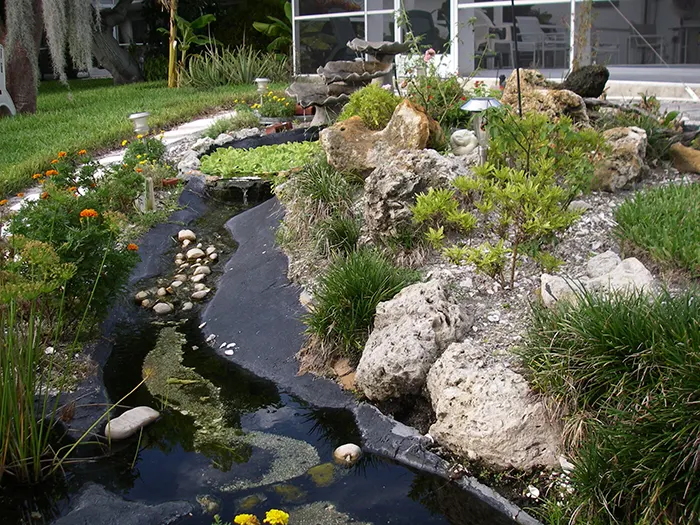
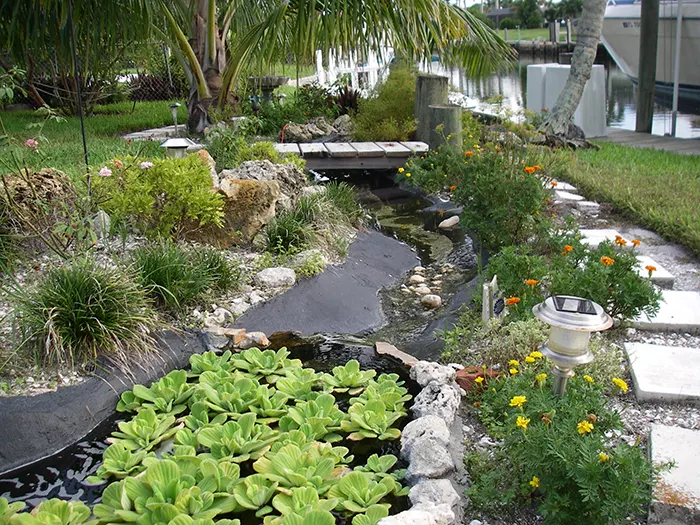
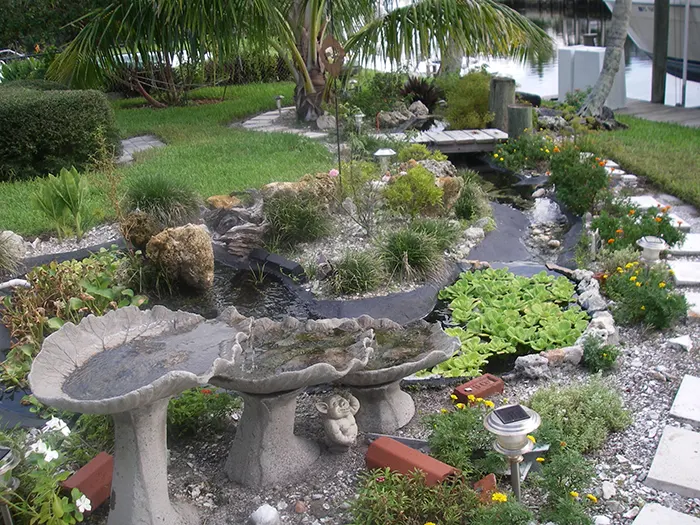
    If you decide you would rather create a free form water feature there are now pond liners you can use. Once again create the shape of your water feature using rope or a hose. Excavate the soil to the desired depth leaving a shallow ledge about half the depth of the pool. You can use the excavated soil to create raised garden beds to make your water feature look more natural. Or you can remove the grass from around the hole to allow for pavers creating a neat edge. Now remove any sharp stones or roots sticking out of the soil and place a cushion of ½ inch of sand on the bottom of the excavated hole. If you have a very rocky soil you can purchase a polyester matting material designed for the job of protecting the pond liner. Now it is time to place the liner in the hole. Drape it loosely in the hole making sure there is sufficient overlap all around. Hold the edges in place with rocks or bricks. Fill with water while lifting the bricks occasionally to allow the liner to settle into the hole. Remove any creases by stretching and adjusting the liner as it fills. Once the pond is full, cut off the extra liner leaving at least 6 inches all the way around. This will be covered and held in place by the pavers or pins and excess dirt used to create your gardens.
    My late husband, Peter, built a magical pond and stream creation in our back yard over 20 years ago using the old lath and plaster method. Our waterfront back yard had just the right slope for a running stream with waterfalls along the way. He dug an upper pond which connected to a lower pond with a winding stream that included mini rapids and several small waterfalls. The water was circulated back to the top using a pump in the lower pond which brought the water back to the upper pond via underground pipes. Unfortunately, several hurricanes damaged the plaster liner causing serious leaks. While still an interesting landscape feature, it has not been a working water feature for over a decade. I plan to resurrect it using flex seal paint to repair the cracks and look forward to the sound of gurgling water and the wildlife it will attract.
    If you want to add plants to your water feature there are many aquatic plants you can purchase. You simply use an old tub or plant them in the containers they come in. There are special planting baskets that you can line with burlap or a special liner to hold in the soil. After planting with soil cover the surface with gravel to hold the plants in place until they have a chance to root. Place them in the shallow areas of your pond. There are also floating plants like water lettuce that your simply place in the water. Be careful not to buy or accept from a well-meaning friend invasive water plants. That is the equivalent of taking invasive cuttings of landscape plants. You will regret it as they spread uncontrollably and take over your water feature.
    If you decide to add fish do not release them into the pond before floating the bag in the pond water for a couple of hours to equalize the temperature of the bag and the pond. And do not leave them in the bag too long as the oxygen can be depleted starving the fish of their much needed oxygen.
    So if you have always wanted a backyard pond next weekend might be a great time to get it done.  Happy excavating!

[yith_woocommerce_ajax_search preset='default']