
Category: All

  • Garden Column

    Garden Column

    This week we celebrate Earth Day.  This holiday was first celebrated in 1970.   It is a great day to think about the beautiful environment surrounding us on Marco Island and how to perhaps create habitats (think your yard) that are more friendly and inviting to the environment and the creatures that call it home.
    The flora and fauna of South Florida are quite diverse, made up of microclimate environments called communities.  Each of these communities has its own plants and animals that rarely leave their own area.  These are broken out as coastal dunes, hammocks, freshwater swamps or wetlands, saltwater wetlands, sand pine scrubs, dry pineland and pond and river margins.  Marco Island has areas that would apply to all of these communities. 
    Coastal dunes B Hideaway beach; Hammocks B Indian Hill or Key Marco; Freshwater swamps or wetlands B Marco Lake; Saltwater wetlands B along Caxambas Drive, behind Sheffield or Key Marco fringe; Sand pine scrub or dry pine land B inland Marco Island and river margins along the Marco River.
    The majority of our flora is tropically oriented.  Nurseries tend to sell a lot of imported exotic plants from other places but there is a trend back to native plants as awareness of water and energy issues arise.  True native plants can better survive our seasonal weather extremes without special care and watering once established.  They also provide habitat for local fauna.  While still hard to find, more and more local nurseries are able to obtain most natives you might want.  The fire bush flowers all year and attracts butterflies and the beauty berry has bright purple berries that the birds love.
    A lot of the more colorful shrubs, which were imports long ago, have become such a common site they are considered by most to be native.  Hibiscus, bougainvillea and ixora are a few examples that fill our landscapes with color.  While they are beautiful, they require constant care from insects and disease, cold damage and extra watering.  A trend toward using exotics more sparingly and introducing more native plants to our landscapes would be a good thing.
    As our island develops the last remaining habitats for our local fauna are disappearing.  Some, such as the egrets and eagles, have adapted to life with man.  Egrets will get in front of my mower and I have to come to a complete stop as they go after the bugs I stir up.  A nesting pair of eagles lived in a nest for over twenty-five years two feet from the back yard of a house I maintained on Shadow Ridge Court.  This lot happens to be at the end of the practice driving range of the Island Country Club.  These eagles endured my lawn mower, weed whip and hedge trimmers as well as the big machine that traverses the driving range picking up the golf balls at the end of the day.  Not to mention the occasional wild ball that probably hit the nest.  I watched many baby eaglets fledge from this nest.  Others, like the pink flamingo and the quail, have slowly perished.  I never got to enjoy the pink flamingos but used to love watching quail families cross the streets.  You rarely see them anymore.  They, like the burrowing owls, lived in our vacant lots, which are mowed regularly.  We now protect the burrowing owls but it is too late for the quails.  One thing we could do to try to save some of our local fauna is to create backyard habitats for wildlife.  This does not necessarily mean you have to have a wild yard.  You should simply think about your plant choices and consider how these plants could help the wildlife you would like to attract.  Provide small fruits and seeds for birds and a source of water.  Have tall grasses or a brush pile for animals to hide in.  Leave open sandy areas and begin a burrow to attract owls or tortoises.  Native plants are a better choice since Florida wildlife evolved with Florida plants.  Maybe the city would consider allowing vacant lots to return to a native state to become mini wildlife refuges.
    To create an environment that suits your property, keep your environmental community in mind.  Don’t try to grow salt sensitive plants on the beach or plants requiring good drainage in low, boggy areas.  A jungle or hammock will be cooler in the summer and warmer in the winter because they maintain a uniform climate of high humidity and frost- free temperatures making then suitable for most tropical plants.  After establishing the more hardy canopy plants you can introduce the more tender, under-story plants as the yard begins to mature.

    Things to remember when creating a habitat are:

    You must provide food, water and cover for the wildlife.

    The habitat area must be at least 10 square yards.

    You should use at least 50 percent native plants in your habitat area.

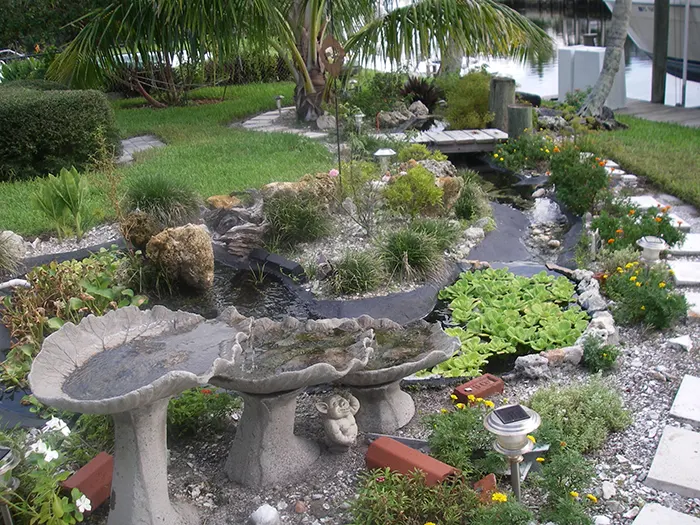
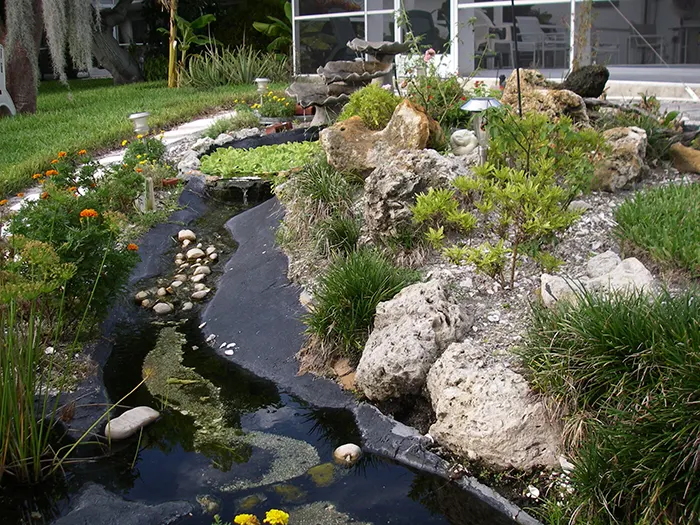
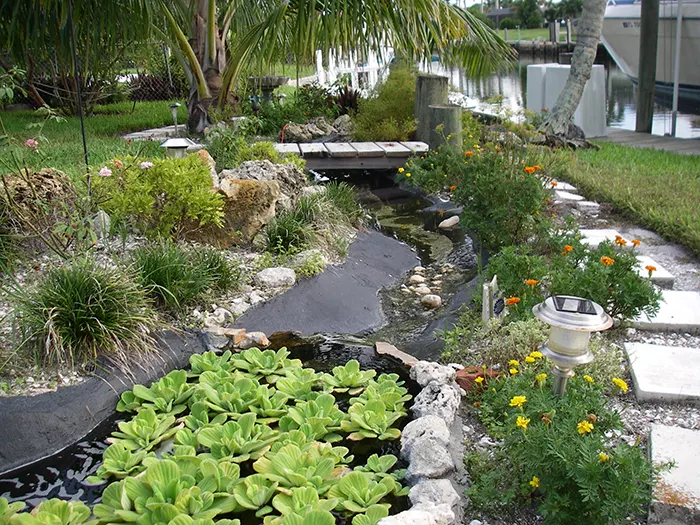
    You do not have to completely re-landscape to establish a habitat. Select a small area of your landscape and add some of the features listed above. An example could be a flower garden to attract butterflies with a birdbath in the middle. The flowers would provide food for the butterfly larvae and the larvae would provide food for birds attracted by the birdbath. We installed a pond system in our back yard and have several bushes and trees with fruits and berries. We love watching our backyard as the diverse species of birds and butterflies come and go. We see cardinals, blackbirds, redheaded woodpeckers, pileated woodpeckers (I just saw one two days ago), purple martins (there are special houses for them), and the favorite with our visitors, a gray heron that feeds on frog eggs from the ponds when available. There are many more I have not identified who stop in on their migration north or south.
    Or, if you have always wanted to live in the woods you can create your own jungle or hammock and screen yourself from your neighbors, street noise, cut your fuel bill and attract birds, butterflies, squirrels and other small creatures to your yard, not to mention spending less time, energy and money keeping a lawn in shape.  The most maintenance needed would be to pick up fallen branches and pull unwanted weeds.  If properly planted, a jungle or hammock on a small lot can be attractive in the wild state.  You can experience and live in the real thing in the community of Key Marco.  Their woods are home to bobcat families with kittens and one of the largest tortoise populations on Marco.  One spring day I watched as a flock of Indigo Buntings flew by in undulating beauty.
    Some animals are happy to live in our neighborhoods as they are, no changes needed.  The homes on Dogwood and Sheffield have similar plant communities and wildlife as does Key Marco with bobcats spotted running through the yards and many tortoise burrows.  In the front yard of one of my homes on Dogwood Drive a very small tortoise burrow appeared in the front lawn.  I only realized what it was because I see so many of these tiny burrows in Key Marco.  I protected it with flags and my crew and I watched as the burrow and the tortoise grew over the summer months.  When the homeowner returned for the season with her dogs we thought the tortoise might abandon the burrow for safer living arrangements, but it stayed put and now lives with our weekly mowing and the dogs.  In the Copperfield Court neighborhood you used to see many rabbits darting from yard to yard taking refuge under hedges and bouncing through the vacant lots.  The end of Laurel Court used to have a resident chicken!  That is until a new house was being constructed and it disappeared.  This chicken would garden alongside me happily eating whatever I stirred up for him.  What a treat.  And let us not forget the snakes.  I have been begging people to leave them alone and not kill them for years.  I do see more large snakes now than I have in the past but we still have a long way to go on that one.  Remember they eat rats and keep the populations down so we don’t have as many in our attics.   
    We are all so fortunate to live on an island surrounded by exotic tropical plants, birds and animals which most people never have the pleasure of seeing in their lifetimes.  Rather than scaring them all away with our development let us develop habitats in our own backyards to attract them to live alongside us here on beautiful Marco Island.  Happy Earth Day everyone!
  • Landscaping

    Landscaping

    When it comes to landscaping, simplicity equals good design and low maintenance. Low maintenance landscapes are designed so that every shrub, tree and flower-bed will all have definite functions. It is best not to over plant and to eliminate as many frills and flower beds as possible. Fewer, well placed gardens help reduce landscape maintenance.
     Arrange your plants in masses. Scattered plants need edging and weeding and can complicate mowing. Avoid planting grass where it is too shady, dry, wet or too steep to be safely mowed. Use ground cover or other plants in these areas. Mulches help to minimize weeds and help retain moisture. Use gravel, bark or pine straw and occasionally pull or spray weeds that come up. Don’t over fertilize. It isn’t a good horticultural practice and results in more pruning or mowing. It also invites insects to all the tender new growth.
    A bed around trees eliminates trimming and speeds mowing. It will help to protect the bark from damage by the lawn tools. Make the beds wide enough so you don’t run into low hanging branches when mowing. Define borders of walks, driveways and beds more clearly with metal, wood or brick edging. This also helps keep stones and mulch in place and the grass from growing into walks, etc. thus reducing trimming. Create paths with gravel, stepping stones or paving where foot traffic is heavy. Be sure walks and gates are wide enough for the lawn maintenance equipment. Power equipment speeds maintenance time.
    Use fences or hedges for privacy or a wind break. A fence would require less space than shrubs or you can select plants which are low maintenance. When planting a vegetable garden only grow what your family can use. Allow enough room between rows for easy cultivation. Power tilling would save hours of hand work. Narrow beds are easier to weed in the center. Large masses of annuals give you bold color with less maintenance.
    Prune trees so the wind can move through them and so more light reaches the grass through the thinned branches.
    Native plants are suited to our local climate and soil and are less susceptible to pest problems making them lower maintenance. Use plants with few insect and disease problems and those that are slow growing for less pruning. Buy quality plants. Replanting or treating sickly plants takes time and money. Inspect your plants before you buy them. Shop at reputable nurseries and garden centers that are neat and well cared for. Don’t buy plants with excessive new growth or with scarred, cracked or peeling trunks or branches. Plants should be compact and not leggy. Inspect leaves for proper shape, size and color and examine them for insects or disease problems. Make sure the root system is not growing out of the pot.
    Nothing is more important than good planting practices. Prepare your planting hole with water, fertilizer and any necessary amendments. Be sure your plant is in a site it prefers. Practice preventative maintenance. Keep plants and lawns well fed and watered and they will be vigorous and healthy. This is the best way to prevent problems which in turn increase maintenance needs.
  • Spring is in the Air

    Spring is in the Air

    April and May can be very dry months averaging only 2.03 inches of potential rain fall.  Add to that the higher temperatures, low humidity and wind and you end up with a high evapotranspiration rate.  Evapotranspiration (ET) is a process by which water is transferred to the atmosphere from vegetative surfaces.  ET consists of two components, evaporation and transpiration.  Evaporation is a physical process by which water is changed from a liquid to a gaseous state.  Evaporation takes place from free water surfaces such as ponds, streams, wet soils or wet vegetation.  Transpiration, the other component of ET, is a plant process of water loss.  That is where the term evapotranspiration came from.
    Here in South Florida our sandy soils can experience drought conditions after only a few days without rain. This condition is made worse by high temperatures. In order for our lawns to survive with little or no water they must be conditioned before a drought occurs.  Supplemental irrigation usually provides adequate water for lawns between rainfalls.  But in the past water management districts have enforced severe water restriction schedules, allowing watering only once a week or less. We are under a twice a week restriction now.  It is important to prepare your lawn for drought now so it will survive such severe restrictions as you never know when a drought will occur.
    Your primary objective is to grow a good healthy lawn that will survive with little or no supplemental irrigation.  A properly prepared lawn will have a deep, extensive root system that can withstand the stress of such reduced irrigation. This can be achieved through proper management practices.
    Proper irrigation is the first step.  Frequent, light watering can cause shallow root systems that are not good for a healthy turf.  To develop a deep root system, water only when the lawn shows the first signs of wilt.  This means twice a week at most and preferably only once a week.  Then apply enough water to wet the soil in the root zone, approximately one inch.
    Knowing the amount of water your sprinkler system applies to your lawn is an important step in using water efficiently.  Most people irrigate for a given number of minutes without knowing how much water they are really applying. Use this method to determine how long to irrigate to apply one inch to your lawn.
    Calibrating or determining the rate of water your sprinkler system applies is an easy job.
    • Obtain five to ten coffee cans, tuna fish cans or other straight sided containers to catch the irrigation water. Containers three to six inches in diameter work best.
    • Place the containers in one zone at a time. Scatter the cans at random within the zone. Repeat the entire procedure in every zone because there may be differences in the irrigation rates.
    • Turn the water on for fifteen minutes.
    • Use a ruler to measure the depth of water in each container. The more precise the measurement, the better your calibration will be. Measurements to the nearest eighth of an inch are adequate.
    • Find the average depth of water collected in the containers by adding the depths and then divide by the number of containers.
    • To determine the irrigation rate in inches per hour multiply the average depth of water times four.

    Try to calibrate the system during the same time the system is normally run so that water pressures are similar. Low water pressure can significantly reduce the amount and coverage of water applied by a sprinkler system. Never apply more than one inch of water per irrigation. Avoid mixing sprinkler head types. Mist heads apply more water than stream and rotor heads. Match sprinkler heads for uniform coverage. Check your system frequently. Replace broken heads, clear clogged nozzles and adjust the direction of spray. Now that you know your sprinkler system irrigation rate, you can more efficiently apply water to your lawn.

    It may take up to six weeks to condition your turf to survive several days or more without wilting between irrigation or rainfall.  During this time the root system is developing and growing deeper into the soil.
    Proper mowing practices are also essential for a drought prepared turf.  Every time a lawn is mowed the grass is stressed which reduces root growth.  Mowing frequency and height of cut should be carefully considered.  The majority of lawns on Marco Island are being cut too short.  Use the highest setting on the mower as a short cut will stress the turf.  By increasing the grass leaf area, more photosynthesis can occur.  This means more carbohydrates for plant growth, especially root growth.  The higher the height of cut on a lawn the deeper and more extensive the root system will be.  Adjust the frequency of mowing to the growth of the turf.  At least once a week in summer, while once a month may be enough in the winter. Try not to cut off more than a third of the blade with each cut.   Also, keep the mower blades sharp.  A clean- cut leaf blade will heal more quickly and thus lose less water than a shredded blade.
    Proper fertilization practices can enhance the drought tolerance of grass.  All the drought conditioning accomplished by proper irrigation and mowing practices may be eliminated by excessive nitrogen fertilization.  Shoot growth is enhanced and root growth reduced by excessive nitrogen.  Drought conditioning can only be accomplished by applying just enough nitrogen to obtain a small, but continuous, amount of growth.  Lawns should never be fertilized to deepen the green color since St. Augustine grass is naturally more yellow-green.  Potassium fertilization promotes increased root growth and thicker cell walls.  Drought tolerance is improved by applying potassium.  Grass requires potassium in nearly the same amount as nitrogen, especially in sandy soils where both can readily leach out.  In times of drought a 15-0-15 lawn fertilizer would be preferable over a 16-0-8 analysis. In addition, the palms in your landscape require more potassium than nitrogen and would also benefit from the higher potassium content in your lawn fertilizer.
    Pest control on lawns should be done with great care during the hot, dry spring months because pesticides can add extra stress through phytotoxicity (chemical damage to plants).  Pesticides should never be applied on a preventative basis. When a pest problem is diagnosed however, it should be treated appropriately as necessary.  Spot treatments can be as effective as treating the whole lawn.  Be particularly watchful for insects and diseases which attack the grass root systems such as grubs or root rots.
    If you have areas in your lawn which will not survive without extraordinary care consider using mulched beds, shrubs and ground covers which do not require supplemental irrigation.
    Even if we begin to have a lot of rain, we should not squander our water.  Prepare your lawn for drought and save our valuable water resources every day of the year.
  • Citrus Tree

    Citrus Tree

    A lot of Marco Island homes have citrus trees in the yard.  Unfortunately, the hurricanes this summer have damaged many of them.  Citrus is not salt tolerant.  Most trees suffer no damage from salt water even though they are in back yards next to canals.  But the constant tropical storm winds carried enough salt in the air to coat the trees with salt and burn the branches and foliage.  If your citrus trees appear to have a lot of dead wood facing the water this is why.  You can have the dead wood trimmed back to healthy, green wood to encourage new growth on the damaged side.  Also, January is one of the months to fertilize citrus so be sure you don’t miss this chance to fertilize.  And to encourage regrowth you may want to lightly fertilize every month through the summer avoiding the time when the tree is flowering.

    The planting and care of citrus trees is very important. Many do not survive due to a lack of understanding of proper care.

    Citrus need full sun and anything less will affect the growth and production of the trees.  Appropriate spacing is necessary as most citrus trees are rapid growers and large round trees.  Plant citrus trees at least 20 to 25 feet apart to allow for mature growth.  Citrus trees should be planted at least 15 feet from buildings or other large ornamentals.

    Before planting clear the area of all grass and weeds.  Add 4 to 5 shovelfuls of organic matter like peat moss or manure to amend sandy soils. Citrus trees will not tolerate sitting in wet soil so avoid planting in boggy areas unless you raise the soil level by building a planting bed.

    Citrus can be planted any time of the year but late winter to early spring is the best time.  Make sure the tree you select is healthy with a nice straight trunk.  If it is diseased or insect infested, or if the roots are coming out of the drain holes indicating a potbound tree, leave these at the nursery.  When ready to plant remove the tree from the growers pot and check for roots which are spiraling around the root ball.  Gently pull these roots free so they protrude from the ball.  If the tap root is coiled at the bottom soak the root ball for several hours in water to allow for some straightening of the tap root and any other badly coiled roots before planting.

    Dig the planting hole large enough that you can spread the roots out if necessary.  Set the plant slightly higher than it grew in the container making sure the bud union (or grafting site) is at least 6 inches above the soil line.  This area of the tree is very vulnerable to infection of foot rot, a soil fungi which are splashed onto the susceptible area.

    Backfill half the hole and compress the soil to remove air pockets.  Water to help settle the soil around the roots and finish filling the hole.  Form a water basin around the tree by making a ring of soil 4 to 6 inches high to allow for adequate watering while the tree is young.  Do not mound the soil around the base of the tree!  Leave the water basin for six months to a year.

    Water your new tree two to three times a week for the first month and then twice a week for the next month.  Taper off to a thorough watering once a week if there has not been adequate rainfall.

    The only pruning necessary on a citrus tree is to remove sprouts or suckers from the trunk or to remove dead wood or crossing branches which could cause damage to the other branches.  Also low hanging branches to allow air flow under the tree.

    Do not fertilize your new tree until it shows signs of new growth.  Spread the fertilizer evenly in your water basin the first year and then enlarge the area after that to cover an area twice the diameter of the tree canopy and water in thoroughly.  Use a balanced citrus special fertilizer with the necessary minor elements four to five times a year the first year.  The first application should be in February and the last in September.  The second year fertilize four times and three times thereafter in January, June and October.

    Citrus can suffer many insect and disease problems.  Listed below are some of these problems.

    Keep the area beneath the canopy free of weeds to the drip line.  The herbicide Round-up is safe for use under citrus.  If you chose to cultivate your weeds keep it shallow as the citrus tree has shallow and widespread feeder roots.  Mulching citrus is not recommended as it can increase the chance of infection by the soil borne fungi which cause foot rot.

    Foot rot is a leading cause of death for dooryard citrus.  This destructive soil borne disease of citrus is encouraged by high soil moisture, planting too deeply, mulching or too many weeds under the canopy of the tree.  Foot rot lesions develop at or just above the bud union and on the bark of the crown roots.  The first sign of infection is drops of gum on the bark.  The bark near the lesion will be brown and slippery.  As the dead bark dries it shrinks and splits, eventually sloughing off and girdling the tree.  The part of the tree fed by the damaged bark dies and so the disease progresses.

    Another common disease of citrus roots is root rot which causes the destruction of the shallow feeder roots mentioned earlier.  Roots infected with this disease will have decaying outer tissue which easily slides off the root.  If new roots don’t regenerate quickly enough the tree starves to death.  Root rot may have no above ground symptoms.  Often the tree will look good one week and be dead the next.

    Cultural practices to follow to avoid these diseases in your citrus trees are as follows:

    • Prune low hanging branches to allow good air circulation and light under the canopy.

    • Plant new trees at or above the level they were in the container – never lower.

    • Keep soil, weeds and brush away from the base of the tree.

    • Avoid mulching which causes high soil moisture.

    • Use chemical rather than mechanical weed control to avoid damaging the trunk and feeder roots.

    You can try to control or slow the progression of the disease on older trees with chemicals if you catch it in the early stages of the disease.  First remove the soil from the base of the trunk and crown (top) roots in an area one to three feet in all directions.  Washing with a low pressure hose is a good way to accomplish this.  Second, remove all diseased tissue including about an inch of healthy tissue beyond.  Third, drench with a systemic fungicide specific for phytophtora.

    Some insects which affect citrus are mites, scale, whitefly, mealybugs, aphids and caterpillars.  There are many beneficial enemies of all of the above pests and they do a good job of keeping these pests under control so you can avoid using chemicals on your trees.  Parasitic wasps, ladybeetle and lacewing larvae, and adult ladybeetle are some of the more common beneficial insects to watch for.  If you should need to spray, Malathion is a good choice for citrus.  Two parasitic fungi infect immature whitefly.  Red Aschersonia form pink and reddish pustules 1/8 inch or less on the underside of the leaves.  It is very colorful and noticeable.  Acgerita or brown whitefly fungus appears as cinnamon pustules also about 1/8 inch diameter on the underside of leaves.  This fungus is often thought to be Florida red scale.  There are other fungi which attack citrus mites, especially in the summer.

    Sooty mold is caused by insect honeydew left on the leaves while feeding.  Controlling these insects will prevent this and an oil spray will help the fungus flake off cleaning the fruit and leaves.  Scab, melanose and greasy spot are all diseases of fruit and leaves of citrus trees.  Copper fungicide sprays will bring these diseases under control if they get out of hand.

    It is best to depend entirely on natural control of insects and disease on your citrus trees.  Many are never sprayed and yet the trees survive and produce good crops of satisfactory fruit.

    There are several other problems homeowners may experience with their citrus trees.  Blossom and fruit drop may just be the tree ridding itself of excess fruit or it could be the result of improper fertilizing.  Be sure to fertilize three times a year with a quality citrus fertilizer.  Do not fertilize while the tree is flowering as the nitrogen can cause the blossoms to fall off.  If you are late with your January fertilization wait until the fruit has formed and set before you fertilize.  Improper watering during the dry spring months when the tree is flowering and setting fruit is another cause of blossom drop.  Be sure to provide irrigation at regular intervals during the dry months.  And strong winds will cause blossoms and small fruit to drop.

    Granulation of citrus fruit causes enlarged, hardened and colorless juice vessels.  Several factors can contribute to this problem.  Young trees are more likely to have this problem than older trees and large fruit more than small.  Leaving the fruit on the tree too late in the season.  High soil moisture.  This condition may be inherent to particular trees as it tends to recur in the same trees year after year.

    Fruit splitting can be a problem in September and October.  Nutritional deficiencies, especially copper, can contribute to this problem.  Or after a series of heavy rains, especially following drought, the tree takes up a lot of moisture and forces it into the fruit.  The fruit is nearing maturity and the rind has become less pliable and splits.  To prevent splitting on future crops use a balanced fertilizer program and make sure you irrigate uniformly during the growing season.

    Citrus canker and citrus greening are two very serious diseases of citrus and I will go into more detail in a later column on these diseases.

    Citrus canker is a serious disease of citrus especially for commercial growers.  It causes unsightly lesions, premature fruit drop and can weaken and kill a tree.  The only sure way to get rid of canker is by destroying infected or exposed trees.  This disease has been discovered in many groves in our area and also in backyards in Golden Gate.  State or federal inspectors may request access to your property to examine your citrus trees if canker is discovered in our area.  They will be from the U.S. Department of Agriculture or Florida Department of Agriculture and Consumer Services.  They will inspect the trees and take samples if canker is suspected.  If the tree is infected it must be destroyed.  Your trees will also be destroyed if they were purchased from a nursery exposed to canker.  This is a necessary evil to protect our commercial citrus groves.

    This disease is highly contagious and can be spread by wind driven rain, lawn mowers, pruning tools, animals and people and the movement of infected plant materials.  As a lawn care company we recently received a notice of quarantine area from the Fl. Dept. of Ag. & Consumer Services.  Within this area they regulate businesses whose activity may result in the spread of canker.  There are special regulations regarding disinfection of personnel, vehicles and equipment and special handling and procedures for moving and disposing of plant clippings and yard debris.  In order to work inside the quarantine area (they provide you with a map detailing the area) all lawn maintenance operators must enter into a May 1999 Compliance Agreement agreeing to follow decontamination procedures.  Failure to do so will result in your business being suspended from working in the quarantine area and a violation.

    The cooperation of all homeowners and horticultural workers is necessary to eradicate citrus canker from Florida so that we can continue to step out the back door for some fresh citrus off the tree.  

  • Fungus

    Fungus

    Wet weather during the hot summer or cooler winter months can cause disease problems for our lawns and shrubs. Fungus spreads rapidly when you have free water on leaf surfaces for too many hours. The evening and early night showers of summer wet plants and lawns going into the night and the cooler winter weather lessens evaporation both of which allow plants and soil to remain wet longer. That means you should water less during the cooler winter months than you do during the hot spring and summer months, once a week as opposed to two or three times a week. I often say winter is a great time of year to save on those water budgets.

    Brown Patch

    Brown patch is a common disease of turf grass affecting both St. Augustine and Bahia. In Southern Florida it is mainly a fall and winter disease but can also occur in the summer months. Grass blades may be killed in a few hours by this fungus. It infects the blade nearest the soil and disrupts transport of water and nutrients to the upper portions of the blade which then die rapidly. The first symptom of the disease is yellowing or chlorosis of the blades. The affected blades dry and turn various shades of reddish brown to straw brown. The fungus is most active at 73 degrees F to 90 degrees F. Excessive nitrogen fertilizer can fuel this fungus. A well balanced fertilizer applied at moderate rates is important in reducing severity of this disease.

    Take-all-Patch

    Take-all-Patch is a serious disease fueled by the summer heat. It affects areas damaged by lack of water, insect or disease problems earlier in the year. The summer rains fuel this fungus and it begins to spread. Special fungicides are required to bring this under control and sometimes the best treatment is to replace the area with new sod. I have devoted columns on this hard to control disease.

    Grey Leaf Spot & Rust

    Two other leaf diseases of turf grass to watch out for are grey leaf spot and rust. Both like warm, wet weather and will cause grass blades to die leaving brown blades throughout an otherwise green lawn. Unlike brown patch disease nitrogen fertilizer can help the lawn recover from these leaf diseases by encouraging new blade growth.

    Ornamental Diseases

    Ornamental diseases caused by fungi include the following. Root rots which are most often caused by excessive soil moisture. The plants will be wilting, yellowing and declining. Stem rots affect the stem near the soil line. The stem will darken, soften and rot. There may be a smell. Leaf spots can be light to dark, small or large, round or with irregular margins. Most leaf spots do not kill the plant but can defoliate them. Rust spores of fungi are normally found on the undersides of the leaves. Wilts affect plants in the water conducting tissues so the plant cannot receive water and will die. This disease may progress slowly or quickly. Powdery mildew grows on the upper and lower sides of leaves. It is white and then turns grey. It is not always serious and is common in low light areas. A powdery mildew was responsible for our loss of impatiens.

    Disease Control

    For disease control, choose healthy plants and treated seeds for planting. Remove and destroy all dead or diseased plants and plant parts from the garden. After pruning clean your equipment with a weak bleach solution to avoid spreading disease from plant to plant with your tools. Allow space between plants. Thinning thick foliage allows more air movement and quicker drying.

    “Applying a fungicide will help protect the surrounding healthy grass from infection.”

    Fungicides

    Spraying and dusting with fungicides should be done before disease begins or spreads too far. Fungicides protect healthy tissue from disease rather than curing infected tissues. Soil borne diseases can be controlled by treatment of the soil with sunlight or fumigants before planting. Two good fungicides for ornamentals are copper or a systemic fungicide. Copper should be used sparingly as it can accumulate and become toxic if used too frequently.


    The best horticultural method for preventing disease is to water in the early morning rather than in the evening. This allows the plants to dry with the sun before the water can begin activating the fungal organisms and spreading the disease. This process begins to happen after four or five hours of continuous moisture on leaf surfaces. Because diseases turn plant leaves and grass blades brown many people mistakenly believe they need to water more to turn the plants or lawn green again. This action will only exacerbate the disease problem as you add more water to fuel the fungus. If you suspect disease allow the area to dry out, treat with a fungicide and when you resume watering dont over do it.

  • Bulb

    Bulb

    Daffodils and tulips are my favorite flowers because it was a sure sign of spring in Connecticut when they began popping up in the fields and yards. While we cannot grow daffodils or tulips this far south we do have some bulbous plants that are beautiful.

    Amaryllis

    These bulbs show pretty green leaf-like foliage in the garden most of the year. One of the most beautiful bulbs we can grow here in South Florida is the amaryllis. They come in varying shades of pinks and reds. Bulbous plants will thrive and produce these beautiful flowers year after year with proper care. These plants have thickened underground storage organs which enable them to survive unfavorable environmental conditions. These underground organs are also the propagative units of the plants. Not all bulbous plants are true bulbs. Other underground storage organs include corms, tubers, tuberous roots and rhizomes.

    Bulb Scales

    A true bulb is a compressed stem or basal plate bearing a flower bud enclosed by thick, fleshy scales called bulb scales. Some true bulbs such as narcissus, amaryllis & tulip are protected from drying and mechanical injury by dry and membranous outer scales called a tunic. Other true bulbs such as lilies are called non-tunicate or scaly because their outer scales are succulent and separate, giving the bulb a scaly appearance.

    The Corm

    A corm is a solid mass of stem tissue with a terminal bud on top. Axillary or lateral buds are also produced at nodes on the corm. The solid stem structure of the corm is protected against injury and water loss by dry leaf bases that are similar to the tunic that encloses true bulbs. Gladiolus is a corm.

    Caladium

    A tuber is a thickened underground stem with many buds on its surface. Tubers are covered with a tough skin rather than a tunic or scales like true bulbs and corms. An example of a tuber is a caladium.

    Dahlia

    Tuberous roots, such as dahlia, are true roots and lack nodes and inter-nodes. Buds are present only at the crown or stem end of the root.


    Rhizomes are thickened horizontal stems growing along or below the surface of the ground. Underground rhizomes of canna and calla produce roots on their lower surface and send shoots above ground.

    “Florida’s climate is favorable for growing many tropical and subtropical bulbous plants.”

    Florida’s Climate

    Florida’s climate is favorable for growing many tropical and subtropical bulbous plants. Unfortunately, many of the common bulbs of northern states such as tulips, hyacinths and daffodil do not grow well in Florida. These bulbs flower poorly or not at all. With special treatment many of these northern bulbs will grow and bloom the first year. Recovery and planting the following year is not recommended since they rarely flower again.

    Well-drained Soil

    Most bulbs thrive in a sunny location. Some, such as caladiums, do best in partial shade. Heavy shade should be avoided as it will cause thin spindly growth and poor foliage color and flowering. Bed preparation is important for successful bulbs. A well-drained soil is important. You should till and amend the soil with three to four inches of organic matter and fertilizer.

    Dig holes to the recommended depth for the various bulbs and plant with points facing up. Firm the soil around and over the bulbs and water.

    Water is Crucial

    Mulch the beds to control weeds. Weeds that do grow through the mulch should be pulled before they become firmly established in the bed.


    Fertilize once or twice during the growing season with a special bulb fertilizer. Bulbs such as tulips which are discarded after flowering do not need fertilizing since they have enough stored food to last through the blooming period.


    Water is crucial when growing bulbs and it is important that they not dry out during growth and flowering.


    Keep the soil moderately moist at all times except when drying off at the end of a growing period.

    Good Cultural Practice

    A good cultural practice is to remove dead blooms before seeds are produced. Flowering in the following season will be reduced if seeds are allowed to set. Removing seeds also adds to the aesthetic value of the plants and may prevent disease problems.


    Many bulbous plants grow best if left in the ground year after year while others may become crowded and bloom poorly. Digging and replanting encourages more uniform and larger flowers.


    True bulbs like amaryllis and hyacinth, develop miniature bulbs, known as bulblets, which grow into offsets. Offsets can be separated from the mother bulb and replanted into the beds. Depending on the kind of bulb, it could take several years before they reach flowering size.

    Corms & Cormels

    Corms, such as gladiolus, produce new corms on top of the old corms, which wither. Miniature corms called cormels are produced between the old and new corms. These can be separated from the mother corms and stored along with the new corms over winter for planting in the spring. Cormels also require two to three years to reach flowering size.


    Tubers (caladiums), tuberous roots (dahlia) and rhizomes (canna, day lily) are propagated by cutting them into sections, each containing at least one bud.

    Tuberous roots that are broken off without a bud are worthless.


    Bulbous plants can be moved anytime except when they are in bloom.


    Some examples of bulbs, corms, tubers, tuberous roots and rhizomes and their flowering seasons:


    Bulbs
    Amaryllis – Spring
    Amazon lily – Winter
    Aztec lily – Spring & Summer
    Blood lily – Summer
    Crinum – Spring & Summer
    Society garlic – Spring, Summer & Fall
    Spider lily – Spring & Summer


    Corms
    Gladiolus – Three months after planting
    Tritonia – Spring & Summer
    Watsonia – Three months after planting


    Tuber
    Caladium – Summer to Fall
    Glorioso lily – March to Summer
    Elephant ears – Spring


    Tuberous Root 
    Dahlia – Early Summer


    Rhizomes
    African lily – Summer & Early Fall
    Butterfly lily – Spring
    Cana – Spring to first frost
    Day lily – Spring & Summer

  • Herbicides

    Herbicides

    Are the weeds invading your turf? The cooler weather of the winter months will mean that it will be safe to have your lawn treated with a herbicide to try and bring them under control. Treating your lawn for weeds with temperatures in the 90’s can stress and damage your turf. There are herbicides labeled for use in hot temperatures but my observations show severe stress to the grass with these products. The result can be a thicker bed of weeds as the grass is unable to compete with the weeds in the damaged state in which it was left. It is best to wait until it is in the mid to low 80’s before having your lawn treated for weeds. So always be patient and wait for those lower temperatures.

    Weeds

    Weeds can get a foothold in your lawn in areas where the grass is thin or weak. Weeds do not overtake healthy turf. St. Augustine is a very aggressive and competitive grass allowing it to compete with weeds. If allowed to, St. Augustine grass could overtake and kill most shrubs in your yard.

    Primary Causes

    Most weeds appear because of improper cultural practices such as mowing too closely or infrequently, improper fertilization or irrigation. These are the primary causes for thin or weak turf. In addition, inadequate control of insects, diseases, and nematodes will also damage the turf and allow weeds to invade.

    Weed Control

    Herbicides may temporarily remove the weeds, however, unless the basic cause of the weakened turf is corrected, weeds will continue to be a major problem. Weed control will only be successful if the turf is returned to a good healthy growing condition. The thick blanket of grass will not allow weeds to germinate at the soil line.

    Pre-emergence Herbicides

    Pre-emergence herbicides provide several weeks of residual control in the soil and will kill the seedling weeds as they emerge. Pre-emergence herbicides should be applied before germination of the weed seeds. The timing of applications of this type of herbicide must coincide with the various germination times of weed species. If applied too late in the growing season the weeds will have germinated and escaped control. Applying the pre-emergence herbicide too early may also result in undesirable control since the control is time limited. Adequate soil moisture is important before and after application so timing for rainfall or irrigation is necessary. Most pre-emergence herbicides will control germinating weed seeds over a six or twelve-week period. The best time for application in South Florida is the first of February.

    Post-emergence Herbicides

    Once weeds have germinated and are actively growing they must be controlled with post-emergence herbicides. Weeds are easier to control when in the seedling stage or large and actively growing. Applications made to weeds under stress may reduce the effectiveness. It sounds strange but you want your weeds to be healthy and vigorously growing when you kill them. Post-emergence herbicides are absorbed through the foliage, roots or both and then trans-located throughout the plant. If conditions are dry, irrigate prior to application to ensure active growth and translocation. Fertilization prior to application is also a good idea. Do not water or mow for several days following herbicide application to give the chemicals time to absorb into the weeds.

    “Do not apply herbicide during extreme hot or cold temperatures to avoid damage to the grass.”

    Atrizine

    Atrizine can be used in St Augustine grass to control most broadleaf and annual grass weeds as a pre-emergent if applied before the weed seeds germinate or a post emergent after germination. Apply every six months (spring and fall) for continued effective pre-emergence weed control. Crabgrass control will require a special herbicide. They have taken the best product off the market but there are some replacements appearing. These are not as effective and so patience and a healthy turf will be necessary when trying to kill crab grass. Do not over water as this can encourage crab grass. Do not apply herbicide during extreme hot or cold temperatures to avoid damage to the grass.

    Trimic

    Trimic can be used in bahia grass to control most broadleaf weeds. Use only herbicides labeled for your type of grass as severe injury or death will usually result if the wrong type of herbicide is applied. Herbicides in general should not be applied to freshly mowed turf or to turf under stress.


    While herbicides can help with the weed control in your lawn the best way to a weed free lawn is to practice good horticultural practices like proper watering, mowing, insect and disease control to prevent weak areas which will be susceptible to weed invasion. Using biological organic amendments is a great way to kick start the soil ecosystem in your yard to help make your lawn lush and green and discourage weed invasion in the first place.

  • Grass Mowing

    Grass Mowing

    Proper mowing of your lawn can kill weeds and chinch bugs, cure disease, save water and provide fertilizer. However, improper mowing can be harmful. Mowing is stressful to grass because it is meant to grow tall, mature and make seeds. Man decided that lawns look better when freshly mowed and most people feel the shorter the better. But a close cut doesn’t do much for your lawn or your water bill

    Roots & Leaves

    Grasses are basal-growing plants. The growing point is at the crown (the area between the root and the blade) of the plant near the soil line. The tips are the oldest part of the blade which means you can cut off their tops without killing them. When you cut the tips, new growth pushes up from the crown. When the mower cuts off those grass tips, it causes severe shock to the grass plant. Grass lives primarily on food manufactured in its blades not on what is drawn up through the roots. Cutting the blades reduces the ability of the plant to manufacture food. That food is used for both top and root growth so the shorter you cut the grass the less root growth you will have. A plant with deep roots will be better able to withstand drought, fight off disease and insects and store food manufactured in the leaves. So the longer the root the healthier the grass.


    Every time the grass is cut the root system is weakened to some degree. When cut too severely, the roots stop growing. Mowing tears the plant and creates ports of entry for disease. Sharp mower blades give a cleaner cut which heals faster. Another problem with close cutting is that it allows sunlight to dry the soil and the additional light will encourage weed seeds to germinate.

    A Thicker Lawn

    Mowing has actually tamed the wild grasses of our past. Mowing grass before it sets seeds prevents sexual reproduction and many grasses respond by reproducing asexually by spreading stolons and rhizomes creating a thicker lawn. How high you mow will also influence the spread of the grass. A higher cut makes healthier grass with deeper roots, more mass for photosynthesis and more stolons and rhizomes for a thicker sod which means less weed invasion.

    Seasonal Mowing

    You should also take into account that grass grows at different rates throughout the seasons. The summer months require more frequent mowing than our cold winter and dry spring months when you should not cut as often. Our coming cold weather will slow the growth and bi-weekly mowing will be all that is needed. Some lawns could go three weeks or a month without mowing. If the grass doesn’t need to be mowed save it from the extra stress and don’t mow it. As we move into the dry spring months grasses will be stressed by heat and drought so care must be taken to properly irrigate to help ease the stress of mowing.

    Watering

    In past years drought required the city to reduce our allowed watering to once a week. The fact is our lawns could easily survive on this schedule and be healthier for it. We should use horticultural practices every day which produce deep-rooted lawns that don’t require excessive water to keep them green. All lawns, properly cared for, could be conditioned to require no more than once a week watering all year. The exception would be during the cold winter months when once every two or three weeks will do.


    I remember the year the Phase 3 water restriction took affect on Marco Island and everybody thought their lawn would surely die if watered only once a week. People were surprised as their lawns remained green and lush. It was because it was during the winter months with the cooler temperatures and lower evaporation rates. That benefit ends as the temperatures begin to climb in March, April and May.


    Spring is when the benefit of a deep root system and tall grass blades come in to play to allow for less watering.

    Sprinkler Systems

    Check your irrigation system to be sure of proper coverage. It may seem that the sprinklers are reaching all areas but if you have dry spots on the edge of your sprinkler pattern you may not be getting adequate water at the edges of the sprinkler pattern. Place some empty tuna cans at the center of the green areas and also in the dry areas and measure the water levels after the zone has run. You’ll most likely find you’re not getting enough in the dry areas. This could be dirt in the sprinkler tip, heads not properly spaced or water pressure problems when the sprinklers are running in the wee hours of the morning. When not mowing every week be sure the sprinkler heads stay well cleared of taller grass blades to allow for proper coverage.

    “Clippings are a very good thing and should be left to break down and feed your lawn.”

    Clippings

    It was once believed that grass clippings were the cause of thatch accumulation in the lawn. It is now known that they do not accumulate unless the clippings are exceptionally long. They break down soon after they hit the ground. In the process they return a lot of nitrogen to the soil. Clippings are a very good thing and should be left to break down and feed your lawn. Just be sure to keep them out of the waterways where nitrogen is not so welcome.


    A lush, green lawn is a beautiful thing. It doesn’t need excessive fertilizer, chemicals and water use to look that way if you just raise the mower deck as high as it will go. A deeper lawn is a healthy lawn!

  • Evapotranspiration

    Evapotranspiration

    ‪If you are one of the people who say it’s summer so I can turn off my sprinklers, this column’s for you. In spite of the fact that we are still in the rainy season, signs of water stress can appear quickly on lawns this time of year. This situation is occurring on Marco this week and last week as well. While this has been a fairly wet summer we have also had dry periods between rain storms. Next week is calling for almost no rain at all. Water is needed in large quantities by a lawn. And it is required more frequently in the hot spring and summer than during the winter. A good example of this process is how quickly the rain waters recede from our area roads after summer rain storms (as long as it isn’t high tide). If you turn your sprinklers off after one of these rain storms be sure to turn them back on if there are no more soaking rains within four or five days. This is especially important if you have new sod or shrubs in areas. These plants have very shallow roots and our soil is sandy.‬

    Transpiration

    Water comprises 80 to 90 percent of the fresh weight of grass and it also plays a fundamental role in the plant metabolism. Only one percent of water absorbed by plants is utilized for metabolic activity. The majority of water absorbed is used for transpiration. This is a plant process in which water is absorbed by the roots, passed through the vascular system, and exited from the plant via the stomata into the atmosphere. Transpiration helps maintain plant temperatures by cooling through the latent heat of vaporization. Similar to our own perspiration. The water absorbed by the plants in the transpiration process also brings nutrients from the soil into the plant. This is one of the reasons the plants look so much healthier after a good rain.‬

    Evapotranspiration

    The amount of water transferred into the atmosphere by evapotranspiration from turf surfaces is governed by a number of environmental factors. Sunlight, relative humidity, temperature, wind and available soil moisture are all controlling elements. Minimal ET rates occur when there are dark, cloudy days with high relative humidity, low temperatures and no wind. Maximum ET rates occur on bright sunny days with low humidity, high temperatures and high winds.‬

    June Through September

    According to a table computed by the United States Department of Agricultural Soil Conservation Service June through September have the highest evapotranspiration rates. These are months which also have the highest irrigation requirements if we don’t have adequate rains. Don’t be misled by light summer rain showers. Often these rains only wet the soil surface and evaporate rapidly. A general rule used in Florida is to apply 3/4 to 1 inch of water one to two times a week in Summer.

    “Water on Wilt” Method

    It is true that too much water can cause damage just like too little water. Most people do not pay close enough attention to their lawns to allow for the “Water on Wilt” method. The result is a lawn which goes into water stress when too little water is applied during periods when we don’t have adequate rainfall. This results in populations of chinch bugs in the dry areas and the need to apply more insecticides to prevent damage. Disease can also become a problem in these stressed areas and once again chemicals will be needed to correct the problem. Good horticultural practices always help diminish the need for more chemicals in our environment.‬

    Rain Sensors

    The best remedy is to have a rain-stat or sensor installed. It will pay for itself the first summer you install it. Installed on the edge of the house, above the drip line, it is a device that is wired to the sprinkler timer and will automatically turn the system off when there has been adequate rainfall. As the wick dries (as the soil would dry) it allows the system to run again. These devices are required by law on all houses. Every home should have one. Call your sprinkler repair company and have a rain sensor installed today and then let it do its job. ‬

    “While the initial investment may be more than the conventional system it will surely pay for itself in the long run.‬”

    Smart Irrigation Systems

    There are also many new smart irrigation systems on the market. These systems sense the need for water in various ways and only allow the system to run if the need is there. While the initial investment may be more than the conventional system it will surely pay for itself in the long run.‬

    What ever method you choose just be sure that you do not allow the lawn to wilt to the point of damage or over water. As mentioned above, both will cause problems that will in turn require the need for more chemical use and that is always a bad thing for the environment‬.

  • Fertilizers Facts

    Fertilizers Facts

    Fall is here and most of you have started thinking about or already have fertilized your lawn, shrubs and trees. I thought a few facts on fertilizers and nutritional needs of plants might help you with your fertilizer choices.

    Sixteen Elements

    There are sixteen known elements required for plant growth and development. Three of these, carbon(C), hydrogen(H), and oxygen(O) are all obtained directly from air and water. The other thirteen elements are supplied by the soil. These are nitrogen (N), phosphorus (P), potassium (K), calcium (Ca), magnesium (Mg), sulfur (S), chlorine (Cl), copper (Cu), zinc (Zn), manganese (Mn), iron (Fe), boron (B), and molybdenum (Mo).

    A Delicate Balance

    These thirteen are elements plants obtain from the soil must be in a slightly soluble form so they can be taken up by the plant’s roots. Each of these elements has a specific function in plant growth and development. If one or more of these nutrients are present in excessive amounts, toxicity or a nutrient imbalance can occur. Or if one or more of these essential elements are in short supply a deficiency can result. Either way plant growth and/or quality may be affected.

    Macro-nutrients

    The nutrients, nitrogen, phosphorus and potassium are the main components, or macro-nutrients, of a suitable fertilizer. The State of Florida is reducing the phosphorus in this equation however as this macro-nutrient is causing pollution problems in local waterways. Sometimes dolomite, a liming material providing both calcium and magnesium, may be included in growing media. Sulfur, the remaining macro-nutrient, may not be a component of the fertilizer and should not be overlooked. Look for fertilizer containing sulfur coated urea nitrogen. This is especially important if you have the dreaded Take-all Patch disease in your lawn.

    Nitrogen

    Nitrogen is available in two basic forms – inorganic and organic. Plants have a preference for the inorganic, or nitrate form of nitrogen. There are two primary organic forms of nitrogen. One is a man made organic called urea. The other form is a naturally occurring organic material such as sewage sludge and manure. These organic forms of nitrogen are converted to the plant preferred inorganic nitrate form by bacterial action in the soil.

    Soluble Nitrates

    The soluble nitrate form of nitrogen is quickly available to the plant causing the rapid growth rate which may cause thin cell walls to develop. Nitrate nitrogen doesn’t last long in the environment. It can leach readily from the soil and may even be lost as a gas. Nutrients should be supplied at the same rate the plant can use them. This means soluble nitrates must be applied frequently in very small amounts.

    “If you have plants which don’t do well around your pool equipment or overflow it may be chlorine toxicity.”

    Micro-nutrients

    The micro-nutrients to be used sparingly are boron, copper, iron, manganese, molybdenum, and zinc. Chlorine ordinarily is not valued as a plant food in fertilizer. It can be injurious if high percentages are present, but small amounts may be beneficial under some conditions. If you have plants which don’t do well around your pool equipment or overflow it may be chlorine toxicity.

    Micro-nutrients

    Micro-nutrients are required by plants in low quantities so you should apply them cautiously. If a deficiency is suspected, it would be unwise to randomly apply all of the micro-nutrients. The result might be correction of one deficiency while inducing a toxicity of another micro-nutrient. This could also lead to an unhealthy plant appearance. Foliar analysis is the most accurate way to determine if a micro-nutrient deficiency is in need of correction.
    The Collier County Extension Office can help you with this test. Individual micro-nutrients are available with suggested rates provided for application. However, it is essential that all micro-nutrients be provided in your fertilizer program at least once a year. Fertilizer formulations are available for shrubs, citrus, palms, etc., containing a good balance of these necessary micro-nutrients. Nutritional sprays are liquid formulations that contain the micro-nutrients. These sprays allow the elements to enter the plant through the leaf surfaces.
    The micro-nutrients can be tied up in our alkaline soil, due to improper pH, when applied as a granular fertilizer and may not be available to the plant. Therefore, when a micro-nutrient deficiency is apparent, it is more effective to apply a nutritional spray.

    Following are some general symptoms of nutrient deficiencies:

    Nitrogen – yellowing of entire plant with lower leaves worse and stunted.

    Phosphorus – main veins of old leaves become purple or reddish.  On fruit trees blossoms drop, fruit is small and matures slowly and few flower buds are formed for next year’s crop.

    Potassium – faint yellowing, then browning of margins on old leaves.  Then veins become yellow.

    Manganese – mottled chlorosis between midrib and primary veins.  Entire leaf may turn yellow but midrib and large veins stay green longest.  Frizzle top, yellowing, dwarfing and distortion.

    Iron – pronounced yellowing on younger leaves with veins appearing as fine green lines, yellow to white if acute.  Dwarf leaves, leaf fall, dead wood, dead tips and reduced growth.

    Magnesium – yellowing begins on margin and near center of old leaf, progresses inward and downward; tip, upper margin and lower central veins may remain green; necrosis and leaf drop.

    Molybdenum – often mistaken for herbicide damage.  Dwarfed leaves with irregular, wrinkled margins and prominent midribs and main veins on your leaves and shoots.

    Boron – plants grow slowly.  Terminal buds die and plant tends to be bushy.  Later, lateral buds die, leaves thicken and fruits, tubers and roots become cracked and discolored.

    Copper – usually confined to peat or muck soils.  Slow growth or complete cessation of growth.  Tips affected first and eventually die back.

    Zinc – leaves become long and narrow, turn yellow and become mottled with dead areas.  Symptoms similar to iron deficiency.

    I hope these facts make this necessary chore in your yard a little easier to understand.

[yith_woocommerce_ajax_search preset='default']