
Category: Environmental

  • Blossom, fruit drop and fruit splitting

    Blossom, fruit drop and fruit splitting

    Blossom and fruit drop and fruit splitting are fairly common problems for fruit trees. While losing blossoms and small fruit from your fruit trees can be disturbing it is usually a natural process. Trees which bloom profusely like the mango and avocado could not possibly hold all of the fruit which forms on each limb and so it sheds the excess. You can also remove some small fruits yourself which will increase the size of those allowed to mature. This is actually a good idea for young newly planted trees to allow the tree to use its energy for growth rather than fruit production.
    Or other stresses could be affecting the tree. A proper fertilizer program should be maintained throughout the year. With little or no fertilizer the tree will not have the essential nutrients for growth and fruit production. A balanced fertilizer containing the proper micro-nutrients and the basic macro-nutrients should be applied several times a year. When nutrition is responsible for blossom and fruit drop, nitrogen deficiency is usually the problem, although phosphorus and zinc deficiencies can also be a problem. The best way to treat a nutritional deficiency is to prevent it using a fertilizer containing all the elements necessary for proper growth. Look for a fertilizer labeled as a fruit special. This blend will have the micro nutrients necessary for fruit production.
    Improper watering is one of the primary causes of blossom and fruit drop. The roots of a citrus tree spread outward, just below the soil surface. The bloom period occurs during the dry season so it is easy for your tree not to receive an adequate supply of moisture. Observing the weather conditions and watering at regular intervals during the dry periods will help prevent fruit loss, not just in citrus but in all fruit trees.
    Poor pollination can also cause problems. Often two types or cultivars of a particular fruit tree are necessary for proper pollination. You can check the subtropical fruit literature at the public library to determine whether your tree requires a pollinator or not.
    Finally, strong winds will cause blossoms and small fruit to drop.  Even mature fruit will fall if the winds are strong enough as those who cleaned up after Hurricanes Andrew and Wilma can attest.
    Fruit splitting usually occurs in September and October. This can happen when not enough copper is available to the tree. Splitting also can be a problem when there is an acute deficiency of other fertilizer elements necessary for plant growth. During certain times of the year there may be periods of heavy rainfall or drought. The problem is often accentuated just after a period of moisture stress followed by heavy rains. The tree takes up considerable moisture and forces it into the fruit. As the fruit nears maturity the rind becomes less pliable and fails to expand properly. Some varieties and young trees are more susceptible to this problem than older bearing trees. There is nothing you can do for the current crop. Next year splitting can be lessened by a balanced fertilizer program containing the necessary minor elements and by more uniform irrigation during the fruiting season. You should remove the affected fruit as it can attract insects.
    And finally, many fruit trees have a habit of bearing a large crop of fruit one year, while resting with a smaller crop the next year.  Keep your trees well fertilized and watered and enjoy the “fruits of your labor”.  Sorry I could not resist.
  • Integrated Pest Management

    Integrated Pest Management

    The regulatory method of Integrated Pest Management includes preventing entry and establishment of foreign pests.  The first line of defense is to identify and then suppress new pests as they are first discovered in limited areas.  If suppression is not achieved you then turn to containing and eradicating the pest.
    The Department of Agriculture and Consumer Services, Division of Plant Industry in Gainesville is responsible for the regulating control necessary to suppress and control the movement of dangerous pests.  This is achieved using a variety of means.
    • Certification, which assures pest free materials are moved between states or countries.
    • Inspection of nurseries and plants being moved to identify and assure control of the spread of harmful pests.
    • Surveys to identify infestations of harmful pests accidentally introduced into an area.
    • Establish and enforce quarantines to prevent movement of harmful pest infestations.
    Even with all of these controls in place new pests and diseases are discovered all of the time. The Division of Plant Industry and University of Florida IFAS Extension release news of new pests via e-mail so that those of us out in the field every day can keep a watchful eye and report and sightings. Following are some of the past releases to be on the look out for and report if you see them.
    Laurel Wilt Disease is a destructive disease of redbay, avocado and other trees in the laurel family (Lauraceae). This fungus infects the sapwood of trees restricting the transport of water causing the leaves to wilt and eventually the tree to die. The fungus is spread to the trees by a non-native insect, the redbay ambrosia beetle first detected in Savannah, Georgia. Laurel wilt has been discovered in an avocado tree in a commercial grove in south Miami-Dade County. To view the signs of laurel wilt disease and the redbay ambrosia beetle Google “Laurel Wilt Disease and Ambrosia Beetle” and report any sightings to the DPI help line at 888-397-1517.
    Royal Palm Bug is being called the chinch bug of royal palms. While they are not considered deadly they do cause considerable aesthetic damage to the fronds from their feeding. Damage is heaviest from mid-March to early July. Damage is minimal after that and resembles manganese deficiency with fronds browning in uneven patterns. Root drenches of Merit have proven effective but the uptake is slow. For immediate results use a foliar application. One soil application of Merit has provided control for two years. To view this problem Google “Royal Palm Bug” and report sightings. I have personally seen this problem on several royal palms on Marco Island.
    Red date scale is attacking our heretofore pest free pygmy date palms (Phoenix roebelenii). Palms planted in shady areas or lanais are most bothered by this pest. Those trees in planted full sun are not as infested. The scale appears in a white waxy material with the occasional red scale showing through. They congregate at the base of newly emerging fronds, on exposed roots and the trunk. This scale is hard to control as it has repeating generations producing a complete new population from egg to adult in only sixty days. Also, it is hard to spot the new infestations as they are in crevices of the newly emerging fronds allowing the population to grow unnoticed. Once again Merit or Bayer Advanced Tree & Shrub Insect Control as a root drench will translocate throughout the plant to provide control for even the hidden pests missed by topical sprays.
    Sri Lanka Weevil (Myllocerus undatus) adult is about ¼ inch long and whitish-gray. They resemble our native weevil the Little leaf notcher but have a spur on the legs and a light yellow head. Their feeding is heaviest when plants are producing new foliage in the spring. They will feed on a wide range of fruit trees, palms, ornamentals and citrus. Lychee and mango trees are favorites. I have seen this weevil on Indian Hawthorn on Marco Island. If you feel control is necessary with severe infestations Sevin or Orthene can be applied. To view this pest Google “Sri Lanka Weevil”.
  • Backyard Pond

    Backyard Pond

    Creating a water feature in your yard used to be difficult back in the day when lath and plaster or concrete were used for construction.  We now have pre-formed pools and pond liners that make for a weekend job.  A water feature is an attractant for birds and other wildlife and can be relaxing when the water is moving creating a peaceful sound. 
    The first step is to decide where you want to locate the water feature. You will want to be able to see it from a deck, patio or windows from inside the house so that you can enjoy watching the wild life that will be attracted to the yard. Also, place it so you can hear the gurgling of the water for the peaceful vibe.
    If using a preformed pool use a piece of rope or hose to outline the pool edges to the ground. Next excavate the hole while following the profile of the pond including any interior shelves. Place the pond into the hole occasionally to check the fit. Make the hole a bit larger than the pond which will make back filling easier. To check the depth of your hole lay a piece of wood across the opening and measure to the bottom. Then place your pool into the hole and check that it is level with the land around it. If you have rocky soil you may want to add a shallow layer of sand to create an even surface for the pool. Now it is time to add water and begin packing soil around the edge. Packing the soil as you fill the pool with water will ensure the levels of the pool remain true to the original shape being especially vigilant under the shelves of your pool. Be sure your back fill does not raise the levels of the edges around your pool.
    If you decide you would rather create a free form water feature there are now pond liners you can use. Once again create the shape of your water feature using rope or a hose. Excavate the soil to the desired depth leaving a shallow ledge about half the depth of the pool. You can use the excavated soil to create raised garden beds to make your water feature look more natural. Or you can remove the grass from around the hole to allow for pavers creating a neat edge. Now remove any sharp stones or roots sticking out of the soil and place a cushion of ½ inch of sand on the bottom of the excavated hole. If you have a very rocky soil you can purchase a polyester matting material designed for the job of protecting the pond liner. Now it is time to place the liner in the hole. Drape it loosely in the hole making sure there is sufficient overlap all around. Hold the edges in place with rocks or bricks. Fill with water while lifting the bricks occasionally to allow the liner to settle into the hole. Remove any creases by stretching and adjusting the liner as it fills. Once the pond is full, cut off the extra liner leaving at least 6 inches all the way around. This will be covered and held in place by the pavers or pins and excess dirt used to create your gardens.
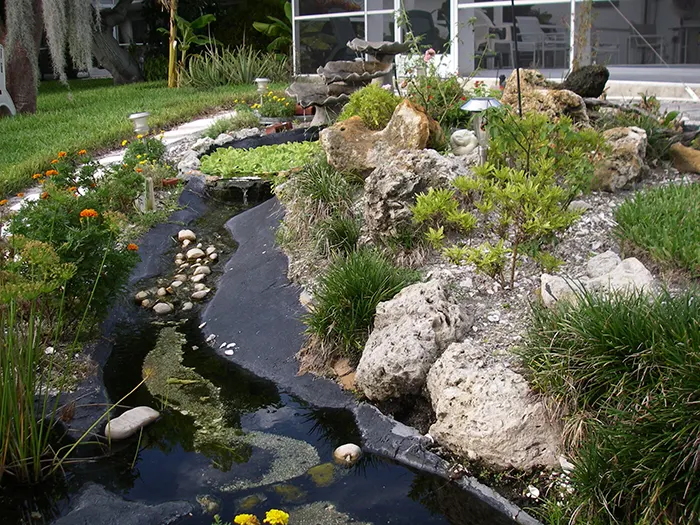
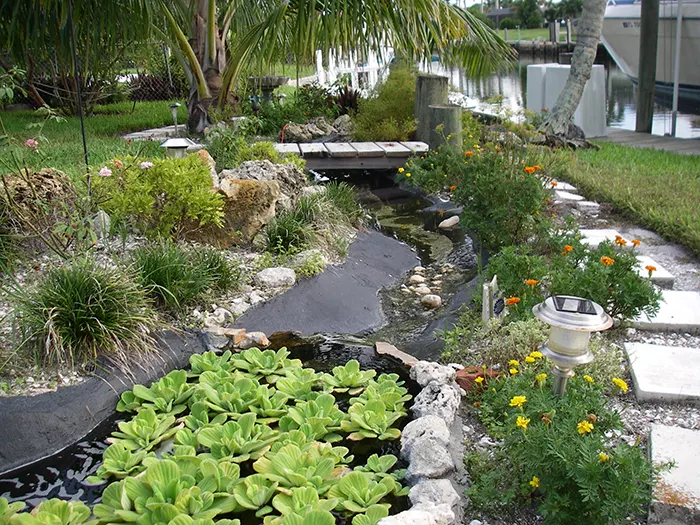
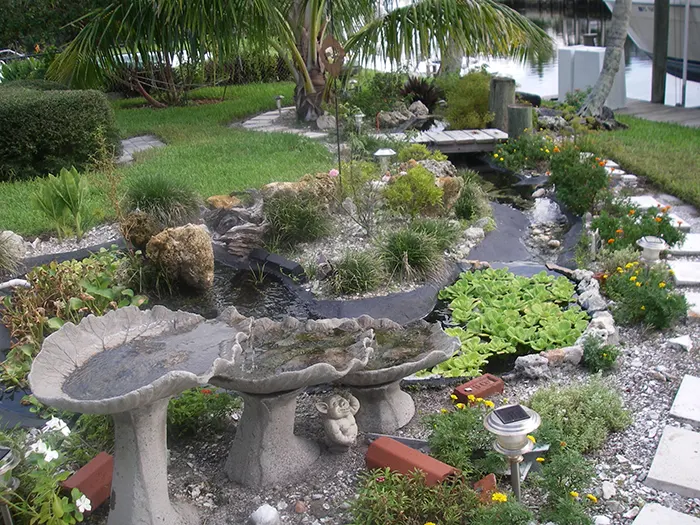
    My late husband, Peter, built a magical pond and stream creation in our back yard over 20 years ago using the old lath and plaster method. Our waterfront back yard had just the right slope for a running stream with waterfalls along the way. He dug an upper pond which connected to a lower pond with a winding stream that included mini rapids and several small waterfalls. The water was circulated back to the top using a pump in the lower pond which brought the water back to the upper pond via underground pipes. Unfortunately, several hurricanes damaged the plaster liner causing serious leaks. While still an interesting landscape feature, it has not been a working water feature for over a decade. I plan to resurrect it using flex seal paint to repair the cracks and look forward to the sound of gurgling water and the wildlife it will attract.
    If you want to add plants to your water feature there are many aquatic plants you can purchase. You simply use an old tub or plant them in the containers they come in. There are special planting baskets that you can line with burlap or a special liner to hold in the soil. After planting with soil cover the surface with gravel to hold the plants in place until they have a chance to root. Place them in the shallow areas of your pond. There are also floating plants like water lettuce that your simply place in the water. Be careful not to buy or accept from a well-meaning friend invasive water plants. That is the equivalent of taking invasive cuttings of landscape plants. You will regret it as they spread uncontrollably and take over your water feature.
    If you decide to add fish do not release them into the pond before floating the bag in the pond water for a couple of hours to equalize the temperature of the bag and the pond. And do not leave them in the bag too long as the oxygen can be depleted starving the fish of their much needed oxygen.
    So if you have always wanted a backyard pond next weekend might be a great time to get it done.  Happy excavating!
  • Hard Summer Months

    Hard Summer Months

    The official start of summer is almost here with the beginning of June.  June is the start of the rainy season as well as the first month of hurricane season.  Here we go!
    Temperatures and humidity begin to rise with highs in the 90s and lows in the 70s. While we may see a lot of rain we may also experience periods with little or no rain. Due to the increased transevaporation rate, these higher temperatures can cause water stress on lawns, shrubs and trees in a short period of time. So it is important to have your sprinkler system on and set to twice a week allowing for one inch of water per week with a rain sensor that will turn the system on and off with ½ inch of rain. That way your system will water even if we have those short bursts of rain that only water a fraction of an inch.
    If you have not fertilized yet you need to get this done. The plants will tolerate the higher temperatures and stress of summer much better if they are healthy and well fed. Also, it is better to not fertilize in the summer as it can cause excessive growth which thins and weakens plant cell walls allowing for disease problems. Not to mention the extra work it will create for all you gardeners out there. Use a lawn fertilizer with 50% slow release nitrogen and equal amounts of nitrogen and potassium. If you have palms in your landscape they will especially like this analysis. An example is a 15-0-15 analysis. For shrubs and palms choose an acid and palm mix which will help lower the ph. of your soil. The ixoras, gardenias and magnolias will do well with this fertilizer along with most of the plants in the landscape. Mulch will help with weed suppression and as it decomposes will also add organic matter to the soil and help to lower the ph.
    Shrubs and trees should be prepared for hurricane season by pruning and trimming back. Formal hedges should be trimmed often enough so that you are trimming only new and supple growth. Individual shrubs that have overgrown the bounds of the garden should be brought under control before the growing season of summer gets underway. You can either head back by trimming all terminal branch ends back to your desired size or thin the shrub by trimming longer branches back into the shrub reducing the overall size of the shrub to allow for summer growth.
    Trees should be thinned of crossing and interfering branches removing any that touch buildings or are too close to overhead power lines. Quite often power outages are caused by overgrown trees blowing into power lines causing short circuits or completely breaking the lines. Also dead branches can disconnect from the trunk and damage anything nearby. So check your trees because the month of June is a good time to contact your tree company to inspect your trees and trim as necessary.
    Palm trees should only be pruned to a 3 o’clock 9 o’clock shape. Never remove so many palm fronds that it goes straight up into the air. Palm trees use their fronds to make food for the tree from the sun through a process called photosynthesis. They also take water from the air for the tree. When you remove too many green fronds the tree’s ability to make food is greatly diminished. Another reason is that the heart or growth point of a palm is in the middle of the fronds directly above the brown wood of the trunk. When you remove too many green fronds it exposes this area and weakens it making the entire top of the palm tree susceptible to breaking off during hurricane winds. The term “hurricane cut” should not mean removing most of the green fronds. It is a bad practice so avoid doing it.

    Most winter annuals are spent and need to be cleaned from your flower gardens if you have not already done so. There are many annuals and perennials that will tolerate our summer heat and rain and can be planted in June. Following are a few:

    • Celosia, Cosmos, Dahlia, Marigold, Portulaca, Salvia, Sunflower, Berbena, Vinca and Zinnia.
    • Bulbs for our area include: Caladium, Canna Lily, Crinium lily , Day Lily, Gloriosa Lily and society garlic.
    Some pests to watch for include aphids, whitefly, scale and caterpillars on shrubs.  And Chinch bugs, grubs and mole crickets on lawns.  And with the start of the rains disease will become more prevalent. 
    Put on your hat, gloves and sunscreen and prepare yourselves for the hard summer months of gardening ahead. June is just the beginning.
  • Flush of growth with the Summer rains

    Flush of growth with the Summer rains

    May is here which means that summer is just around the corner.  May temperatures usually average highs in the 80’s and lows in the 70’s.  We will have some rain but not as much as June will bring.  Watch your lawn for water needs.  If you turn your sprinklers off because of rain don’t forget to turn them back on.  It is very hot and our sandy soil will dry out quickly.  Once again, I would advise everyone to have a rain-sensor installed to turn the sprinklers on and off automatically after rains.  This devise won’t forget to turn the system back on the way people do.  In the past we have been under watering restrictions this time of year, allowing only two days of watering a week.  This is not the hardship people think it is as two days a week is really all you should have to water if you condition your lawn by watering less often and growing deep root systems.  With droughts becoming more severe we may find restrictions in the future that allow for one day only.  If you have a deep root system you should have few problems with that.
    The spring flush of growth which your plants experienced has now hardened but there will be another flush of growth with the summer rains. And along with this new growth will be more aphids to enjoy the new, tender tips of your plants. They excrete a honey dew like substance onto the stems and leaves of the plants they are feeding on. This honeydew is soon attacked by a black, sooty mold. Some people mistake this for disease and treat with a fungicide when they should apply an insecticide for the aphids or other sucking insects. You can wash this unsightly sooty mold off with a strong hose. Scale, whitefly, thrips and various worms and caterpillars will also be a problem on your plants in May.
    On the lawn, mole crickets begin to hatch around the end of May or early June. These insects are more of a problem in Bahia grass than St. Augustine grass. However, they have been known to attack and damage St. Augustine. They loosen the soil and feed on the roots of the grass. Look for yellow streaks and a softness of the soil which you can feel when you walk on the lawn. Treat quickly with mole cricket bait. Also, mole crickets are attracted to bright light. It would be helpful to use yellow colored, bug lights in your outside fixtures so you don’t attract this insect to your lawn.
    Chinch bugs can become active after any rains we may have. Be sure to watch for yellowing of the grass blades especially along sidewalks and driveways or along edges of damaged areas in the lawn. Treat with insecticide labeled for chinch bugs.
    Gardenias are blooming profusely. When they are finished blooming is the time to prune them back if you are going to. Remember that gardenias set flowers on old growth so you want to prune now and leave the plant alone until it flowers again next spring. Some varieties will bloom year round. Be sure to prune selectively leaving some old growth for flowering each time you prune.
    A lot of bulbs have finished flowering. Remove the old flower stalks and seed pods as soon as possible as they take strength from the bulb and could adversely affect next years’ flowering. You can plant the seeds for new plants but it will take several years for the new plants to flower. This is also a good time to dig your bulbs and separate the bulblets for replanting. These will also take years to flower for the first time.
    Winter annuals are already showing signs of stress from the heat. By the end of May most will be ready for removal. It is time to plant summer annuals in their place. You may want to plant some perennials and bulbs in with your annuals so you don’t have to replace entire beds at one time. Some summer annuals are celosia, coleus, crossandra, gaillardia, gazania, marigold, nicotiana, ornamental pepper, pentas, portulaca, salvia, vinca and zinnia.
    You can prune your flowering trees if they have finished flowering. May is also a good month to plant and transplant ornamentals and trees. Wait for the drought to be over first.
    Remember, summer is just around the corner and with summer comes the rain and the tremendous growth of everything in your yard. Are you ready?
  • Pretty pink trees blooming in the Medians

    Pretty pink trees blooming in the Medians

    There are many flowering shrubs and trees either in bloom or just beginning to bloom right now around Marco Island.  Several people have asked me about the pretty pink trees blooming in the medians.
    The Tabebuia heterophylla or pink tabebuia is a variety that will grow to 50 feet and so needs plenty of room.  There is also a dwarf variety, T. bahamensis which will only grow to 7 feet. This is the variety you see blooming right now in the medians.  Most landscapes are too small for the larger variety so be sure what you are buying.   
    The Tabebuia caraiba is a beautiful, yellow tree that is also blooming along our streets. They grow to 25 feet in height and have a compact, upright habit of growth making them a good choice when space is limited. The tree is deciduous in winter and will make quite a mess while losing its leaves. The reward is the bell shaped, yellow flower produced in profuse clusters before the new foliage forms. They prefer full sun, average moisture and good drainage. No pests bother this tree.
    The Hong Kong Orchid tree has an orchid like flower 6 inches wide and rose-purple in color. The flower has a delightful scent which fills the air around the tree. They are an open, spreading shade tree which will grow to 35 or 40 feet in height with a 30 foot spread. The tree is evergreen but loses some leaves when in bloom. They prefer full sun, moist to semi-moist, well-drained soil conditions. There is also a pure white flowered variety, B. purpurea candida, which they have planted along with the pink tabs in the medians.
    The Frangipani Plumeria is also getting ready to flower. This is another fragrant tree which fills the air with a nice, light scent. The flower is used to make the Hawaiian lei. They are a small broad crowned tree which will grow to 20 feet in height with a 15 to 20 foot spread. The flowers come in yellow, pink or white. They lose their leaves in the fall although there is a variety that does not defoliate. The stiff, thick branches are interesting with no foliage until they begin to flower in spring and summer. Full sun is best with rich, moist loam.
    The Confederate Jasmine is a woody vine with pure white, 1 inch fragrant flowers. They will grow to 20 feet if supported with arbors or trellises. This vine can also be trained in espalier fashion. The Jasmine Minima is a dwarf ground cover variety and lacks the fragrant flowers. San Marco Villas on San Marco Road has beds of the confederate jasmine throughout the front landscaping. You can smell it in the air when you drive by.
    The Gardenia is a rounded shrub which will grow to 8 feet tall by 6 feet wide. They produce handsome, white flowers up to 5 inches wide in the spring and early summer. The gardenia is valued especially for its fragrance. They prefer sunny locations with fertile soil and good moisture. Pests which attack the gardenia are aphids, scales, mealybugs, white fly and nematodes. It is best to by grafted stock.
    The Bougainvillea is also entering the height of its flowering season. It has had a setback because of the desiccating winds of past winter storms. Look more closely if your bougainvillea looks dead on the one or more sides. If you see the new leaves already emerging leave it alone and it will begin flowering before you know it. The various reds and purples of this plant are bright spots in the landscape. They have an upright, sucker growth which will add several feet to the shrub each season. They are a very thorny stemmed plant. A less thorny species has the rose red flower bracts. A dwarf variety has a low compact growth habit. The bougainvillea thrives best in full sun with normal watering. They won’t flower as well when planted in a moist soil or shady location. This is another plant suitable for espalier, arbors or even climbing trees. They are also good for use in pots.
    These are just some of the flowering shrubs and trees which help to make Marco a colorful place to be in the spring. Enjoy the color Marco Island!
  • Garden Column

    Garden Column

    This week we celebrate Earth Day.  This holiday was first celebrated in 1970.   It is a great day to think about the beautiful environment surrounding us on Marco Island and how to perhaps create habitats (think your yard) that are more friendly and inviting to the environment and the creatures that call it home.
    The flora and fauna of South Florida are quite diverse, made up of microclimate environments called communities.  Each of these communities has its own plants and animals that rarely leave their own area.  These are broken out as coastal dunes, hammocks, freshwater swamps or wetlands, saltwater wetlands, sand pine scrubs, dry pineland and pond and river margins.  Marco Island has areas that would apply to all of these communities. 
    Coastal dunes B Hideaway beach; Hammocks B Indian Hill or Key Marco; Freshwater swamps or wetlands B Marco Lake; Saltwater wetlands B along Caxambas Drive, behind Sheffield or Key Marco fringe; Sand pine scrub or dry pine land B inland Marco Island and river margins along the Marco River.
    The majority of our flora is tropically oriented.  Nurseries tend to sell a lot of imported exotic plants from other places but there is a trend back to native plants as awareness of water and energy issues arise.  True native plants can better survive our seasonal weather extremes without special care and watering once established.  They also provide habitat for local fauna.  While still hard to find, more and more local nurseries are able to obtain most natives you might want.  The fire bush flowers all year and attracts butterflies and the beauty berry has bright purple berries that the birds love.
    A lot of the more colorful shrubs, which were imports long ago, have become such a common site they are considered by most to be native.  Hibiscus, bougainvillea and ixora are a few examples that fill our landscapes with color.  While they are beautiful, they require constant care from insects and disease, cold damage and extra watering.  A trend toward using exotics more sparingly and introducing more native plants to our landscapes would be a good thing.
    As our island develops the last remaining habitats for our local fauna are disappearing.  Some, such as the egrets and eagles, have adapted to life with man.  Egrets will get in front of my mower and I have to come to a complete stop as they go after the bugs I stir up.  A nesting pair of eagles lived in a nest for over twenty-five years two feet from the back yard of a house I maintained on Shadow Ridge Court.  This lot happens to be at the end of the practice driving range of the Island Country Club.  These eagles endured my lawn mower, weed whip and hedge trimmers as well as the big machine that traverses the driving range picking up the golf balls at the end of the day.  Not to mention the occasional wild ball that probably hit the nest.  I watched many baby eaglets fledge from this nest.  Others, like the pink flamingo and the quail, have slowly perished.  I never got to enjoy the pink flamingos but used to love watching quail families cross the streets.  You rarely see them anymore.  They, like the burrowing owls, lived in our vacant lots, which are mowed regularly.  We now protect the burrowing owls but it is too late for the quails.  One thing we could do to try to save some of our local fauna is to create backyard habitats for wildlife.  This does not necessarily mean you have to have a wild yard.  You should simply think about your plant choices and consider how these plants could help the wildlife you would like to attract.  Provide small fruits and seeds for birds and a source of water.  Have tall grasses or a brush pile for animals to hide in.  Leave open sandy areas and begin a burrow to attract owls or tortoises.  Native plants are a better choice since Florida wildlife evolved with Florida plants.  Maybe the city would consider allowing vacant lots to return to a native state to become mini wildlife refuges.
    To create an environment that suits your property, keep your environmental community in mind.  Don’t try to grow salt sensitive plants on the beach or plants requiring good drainage in low, boggy areas.  A jungle or hammock will be cooler in the summer and warmer in the winter because they maintain a uniform climate of high humidity and frost- free temperatures making then suitable for most tropical plants.  After establishing the more hardy canopy plants you can introduce the more tender, under-story plants as the yard begins to mature.

    Things to remember when creating a habitat are:

    You must provide food, water and cover for the wildlife.

    The habitat area must be at least 10 square yards.

    You should use at least 50 percent native plants in your habitat area.

    You do not have to completely re-landscape to establish a habitat. Select a small area of your landscape and add some of the features listed above. An example could be a flower garden to attract butterflies with a birdbath in the middle. The flowers would provide food for the butterfly larvae and the larvae would provide food for birds attracted by the birdbath. We installed a pond system in our back yard and have several bushes and trees with fruits and berries. We love watching our backyard as the diverse species of birds and butterflies come and go. We see cardinals, blackbirds, redheaded woodpeckers, pileated woodpeckers (I just saw one two days ago), purple martins (there are special houses for them), and the favorite with our visitors, a gray heron that feeds on frog eggs from the ponds when available. There are many more I have not identified who stop in on their migration north or south.
    Or, if you have always wanted to live in the woods you can create your own jungle or hammock and screen yourself from your neighbors, street noise, cut your fuel bill and attract birds, butterflies, squirrels and other small creatures to your yard, not to mention spending less time, energy and money keeping a lawn in shape.  The most maintenance needed would be to pick up fallen branches and pull unwanted weeds.  If properly planted, a jungle or hammock on a small lot can be attractive in the wild state.  You can experience and live in the real thing in the community of Key Marco.  Their woods are home to bobcat families with kittens and one of the largest tortoise populations on Marco.  One spring day I watched as a flock of Indigo Buntings flew by in undulating beauty.
    Some animals are happy to live in our neighborhoods as they are, no changes needed.  The homes on Dogwood and Sheffield have similar plant communities and wildlife as does Key Marco with bobcats spotted running through the yards and many tortoise burrows.  In the front yard of one of my homes on Dogwood Drive a very small tortoise burrow appeared in the front lawn.  I only realized what it was because I see so many of these tiny burrows in Key Marco.  I protected it with flags and my crew and I watched as the burrow and the tortoise grew over the summer months.  When the homeowner returned for the season with her dogs we thought the tortoise might abandon the burrow for safer living arrangements, but it stayed put and now lives with our weekly mowing and the dogs.  In the Copperfield Court neighborhood you used to see many rabbits darting from yard to yard taking refuge under hedges and bouncing through the vacant lots.  The end of Laurel Court used to have a resident chicken!  That is until a new house was being constructed and it disappeared.  This chicken would garden alongside me happily eating whatever I stirred up for him.  What a treat.  And let us not forget the snakes.  I have been begging people to leave them alone and not kill them for years.  I do see more large snakes now than I have in the past but we still have a long way to go on that one.  Remember they eat rats and keep the populations down so we don’t have as many in our attics.   
    We are all so fortunate to live on an island surrounded by exotic tropical plants, birds and animals which most people never have the pleasure of seeing in their lifetimes.  Rather than scaring them all away with our development let us develop habitats in our own backyards to attract them to live alongside us here on beautiful Marco Island.  Happy Earth Day everyone!
  • Landscaping

    Landscaping

    When it comes to landscaping, simplicity equals good design and low maintenance. Low maintenance landscapes are designed so that every shrub, tree and flower-bed will all have definite functions. It is best not to over plant and to eliminate as many frills and flower beds as possible. Fewer, well placed gardens help reduce landscape maintenance.
     Arrange your plants in masses. Scattered plants need edging and weeding and can complicate mowing. Avoid planting grass where it is too shady, dry, wet or too steep to be safely mowed. Use ground cover or other plants in these areas. Mulches help to minimize weeds and help retain moisture. Use gravel, bark or pine straw and occasionally pull or spray weeds that come up. Don’t over fertilize. It isn’t a good horticultural practice and results in more pruning or mowing. It also invites insects to all the tender new growth.
    A bed around trees eliminates trimming and speeds mowing. It will help to protect the bark from damage by the lawn tools. Make the beds wide enough so you don’t run into low hanging branches when mowing. Define borders of walks, driveways and beds more clearly with metal, wood or brick edging. This also helps keep stones and mulch in place and the grass from growing into walks, etc. thus reducing trimming. Create paths with gravel, stepping stones or paving where foot traffic is heavy. Be sure walks and gates are wide enough for the lawn maintenance equipment. Power equipment speeds maintenance time.
    Use fences or hedges for privacy or a wind break. A fence would require less space than shrubs or you can select plants which are low maintenance. When planting a vegetable garden only grow what your family can use. Allow enough room between rows for easy cultivation. Power tilling would save hours of hand work. Narrow beds are easier to weed in the center. Large masses of annuals give you bold color with less maintenance.
    Prune trees so the wind can move through them and so more light reaches the grass through the thinned branches.
    Native plants are suited to our local climate and soil and are less susceptible to pest problems making them lower maintenance. Use plants with few insect and disease problems and those that are slow growing for less pruning. Buy quality plants. Replanting or treating sickly plants takes time and money. Inspect your plants before you buy them. Shop at reputable nurseries and garden centers that are neat and well cared for. Don’t buy plants with excessive new growth or with scarred, cracked or peeling trunks or branches. Plants should be compact and not leggy. Inspect leaves for proper shape, size and color and examine them for insects or disease problems. Make sure the root system is not growing out of the pot.
    Nothing is more important than good planting practices. Prepare your planting hole with water, fertilizer and any necessary amendments. Be sure your plant is in a site it prefers. Practice preventative maintenance. Keep plants and lawns well fed and watered and they will be vigorous and healthy. This is the best way to prevent problems which in turn increase maintenance needs.
  • Spring is in the Air

    Spring is in the Air

    April and May can be very dry months averaging only 2.03 inches of potential rain fall.  Add to that the higher temperatures, low humidity and wind and you end up with a high evapotranspiration rate.  Evapotranspiration (ET) is a process by which water is transferred to the atmosphere from vegetative surfaces.  ET consists of two components, evaporation and transpiration.  Evaporation is a physical process by which water is changed from a liquid to a gaseous state.  Evaporation takes place from free water surfaces such as ponds, streams, wet soils or wet vegetation.  Transpiration, the other component of ET, is a plant process of water loss.  That is where the term evapotranspiration came from.
    Here in South Florida our sandy soils can experience drought conditions after only a few days without rain. This condition is made worse by high temperatures. In order for our lawns to survive with little or no water they must be conditioned before a drought occurs.  Supplemental irrigation usually provides adequate water for lawns between rainfalls.  But in the past water management districts have enforced severe water restriction schedules, allowing watering only once a week or less. We are under a twice a week restriction now.  It is important to prepare your lawn for drought now so it will survive such severe restrictions as you never know when a drought will occur.
    Your primary objective is to grow a good healthy lawn that will survive with little or no supplemental irrigation.  A properly prepared lawn will have a deep, extensive root system that can withstand the stress of such reduced irrigation. This can be achieved through proper management practices.
    Proper irrigation is the first step.  Frequent, light watering can cause shallow root systems that are not good for a healthy turf.  To develop a deep root system, water only when the lawn shows the first signs of wilt.  This means twice a week at most and preferably only once a week.  Then apply enough water to wet the soil in the root zone, approximately one inch.
    Knowing the amount of water your sprinkler system applies to your lawn is an important step in using water efficiently.  Most people irrigate for a given number of minutes without knowing how much water they are really applying. Use this method to determine how long to irrigate to apply one inch to your lawn.
    Calibrating or determining the rate of water your sprinkler system applies is an easy job.
    • Obtain five to ten coffee cans, tuna fish cans or other straight sided containers to catch the irrigation water. Containers three to six inches in diameter work best.
    • Place the containers in one zone at a time. Scatter the cans at random within the zone. Repeat the entire procedure in every zone because there may be differences in the irrigation rates.
    • Turn the water on for fifteen minutes.
    • Use a ruler to measure the depth of water in each container. The more precise the measurement, the better your calibration will be. Measurements to the nearest eighth of an inch are adequate.
    • Find the average depth of water collected in the containers by adding the depths and then divide by the number of containers.
    • To determine the irrigation rate in inches per hour multiply the average depth of water times four.

    Try to calibrate the system during the same time the system is normally run so that water pressures are similar. Low water pressure can significantly reduce the amount and coverage of water applied by a sprinkler system. Never apply more than one inch of water per irrigation. Avoid mixing sprinkler head types. Mist heads apply more water than stream and rotor heads. Match sprinkler heads for uniform coverage. Check your system frequently. Replace broken heads, clear clogged nozzles and adjust the direction of spray. Now that you know your sprinkler system irrigation rate, you can more efficiently apply water to your lawn.

    It may take up to six weeks to condition your turf to survive several days or more without wilting between irrigation or rainfall.  During this time the root system is developing and growing deeper into the soil.
    Proper mowing practices are also essential for a drought prepared turf.  Every time a lawn is mowed the grass is stressed which reduces root growth.  Mowing frequency and height of cut should be carefully considered.  The majority of lawns on Marco Island are being cut too short.  Use the highest setting on the mower as a short cut will stress the turf.  By increasing the grass leaf area, more photosynthesis can occur.  This means more carbohydrates for plant growth, especially root growth.  The higher the height of cut on a lawn the deeper and more extensive the root system will be.  Adjust the frequency of mowing to the growth of the turf.  At least once a week in summer, while once a month may be enough in the winter. Try not to cut off more than a third of the blade with each cut.   Also, keep the mower blades sharp.  A clean- cut leaf blade will heal more quickly and thus lose less water than a shredded blade.
    Proper fertilization practices can enhance the drought tolerance of grass.  All the drought conditioning accomplished by proper irrigation and mowing practices may be eliminated by excessive nitrogen fertilization.  Shoot growth is enhanced and root growth reduced by excessive nitrogen.  Drought conditioning can only be accomplished by applying just enough nitrogen to obtain a small, but continuous, amount of growth.  Lawns should never be fertilized to deepen the green color since St. Augustine grass is naturally more yellow-green.  Potassium fertilization promotes increased root growth and thicker cell walls.  Drought tolerance is improved by applying potassium.  Grass requires potassium in nearly the same amount as nitrogen, especially in sandy soils where both can readily leach out.  In times of drought a 15-0-15 lawn fertilizer would be preferable over a 16-0-8 analysis. In addition, the palms in your landscape require more potassium than nitrogen and would also benefit from the higher potassium content in your lawn fertilizer.
    Pest control on lawns should be done with great care during the hot, dry spring months because pesticides can add extra stress through phytotoxicity (chemical damage to plants).  Pesticides should never be applied on a preventative basis. When a pest problem is diagnosed however, it should be treated appropriately as necessary.  Spot treatments can be as effective as treating the whole lawn.  Be particularly watchful for insects and diseases which attack the grass root systems such as grubs or root rots.
    If you have areas in your lawn which will not survive without extraordinary care consider using mulched beds, shrubs and ground covers which do not require supplemental irrigation.
    Even if we begin to have a lot of rain, we should not squander our water.  Prepare your lawn for drought and save our valuable water resources every day of the year.
  • Evapotranspiration

    Evapotranspiration

    ‪If you are one of the people who say it’s summer so I can turn off my sprinklers, this column’s for you. In spite of the fact that we are still in the rainy season, signs of water stress can appear quickly on lawns this time of year. This situation is occurring on Marco this week and last week as well. While this has been a fairly wet summer we have also had dry periods between rain storms. Next week is calling for almost no rain at all. Water is needed in large quantities by a lawn. And it is required more frequently in the hot spring and summer than during the winter. A good example of this process is how quickly the rain waters recede from our area roads after summer rain storms (as long as it isn’t high tide). If you turn your sprinklers off after one of these rain storms be sure to turn them back on if there are no more soaking rains within four or five days. This is especially important if you have new sod or shrubs in areas. These plants have very shallow roots and our soil is sandy.‬

    Transpiration

    Water comprises 80 to 90 percent of the fresh weight of grass and it also plays a fundamental role in the plant metabolism. Only one percent of water absorbed by plants is utilized for metabolic activity. The majority of water absorbed is used for transpiration. This is a plant process in which water is absorbed by the roots, passed through the vascular system, and exited from the plant via the stomata into the atmosphere. Transpiration helps maintain plant temperatures by cooling through the latent heat of vaporization. Similar to our own perspiration. The water absorbed by the plants in the transpiration process also brings nutrients from the soil into the plant. This is one of the reasons the plants look so much healthier after a good rain.‬

    Evapotranspiration

    The amount of water transferred into the atmosphere by evapotranspiration from turf surfaces is governed by a number of environmental factors. Sunlight, relative humidity, temperature, wind and available soil moisture are all controlling elements. Minimal ET rates occur when there are dark, cloudy days with high relative humidity, low temperatures and no wind. Maximum ET rates occur on bright sunny days with low humidity, high temperatures and high winds.‬

    June Through September

    According to a table computed by the United States Department of Agricultural Soil Conservation Service June through September have the highest evapotranspiration rates. These are months which also have the highest irrigation requirements if we don’t have adequate rains. Don’t be misled by light summer rain showers. Often these rains only wet the soil surface and evaporate rapidly. A general rule used in Florida is to apply 3/4 to 1 inch of water one to two times a week in Summer.

    “Water on Wilt” Method

    It is true that too much water can cause damage just like too little water. Most people do not pay close enough attention to their lawns to allow for the “Water on Wilt” method. The result is a lawn which goes into water stress when too little water is applied during periods when we don’t have adequate rainfall. This results in populations of chinch bugs in the dry areas and the need to apply more insecticides to prevent damage. Disease can also become a problem in these stressed areas and once again chemicals will be needed to correct the problem. Good horticultural practices always help diminish the need for more chemicals in our environment.‬

    Rain Sensors

    The best remedy is to have a rain-stat or sensor installed. It will pay for itself the first summer you install it. Installed on the edge of the house, above the drip line, it is a device that is wired to the sprinkler timer and will automatically turn the system off when there has been adequate rainfall. As the wick dries (as the soil would dry) it allows the system to run again. These devices are required by law on all houses. Every home should have one. Call your sprinkler repair company and have a rain sensor installed today and then let it do its job. ‬

    “While the initial investment may be more than the conventional system it will surely pay for itself in the long run.‬”

    Smart Irrigation Systems

    There are also many new smart irrigation systems on the market. These systems sense the need for water in various ways and only allow the system to run if the need is there. While the initial investment may be more than the conventional system it will surely pay for itself in the long run.‬

    What ever method you choose just be sure that you do not allow the lawn to wilt to the point of damage or over water. As mentioned above, both will cause problems that will in turn require the need for more chemical use and that is always a bad thing for the environment‬.

[yith_woocommerce_ajax_search preset='default']